JOURNAL / 2026.07.26
Anthropic launches Claude Opus 5 for agents and coding
Opus 5 brings Fable 5-level performance closer to the price of Opus 4.8, with an emphasis on steadier agents that verify their work and sustain long tasks.
Anthropic released Claude Opus 5 on July 24, its new high-end model for everyday use. The important comparison is not with a particular cloud route but with the other tiers in the family: Anthropic says Opus 5 approaches Fable 5’s capability on many tasks, costs roughly half as much per task, and retains the price of its predecessor, Opus 4.8. It is available on paid plans, Claude Code, and the API at $5 per million input tokens and $25 per million output tokens.
The proposition is interesting because the improvement is not framed merely as “more intelligence.” Opus 5 supports effort levels that trade cost for depth, and Anthropic describes it as more consistent at verifying results, recovering from errors, and continuing until long-running work is complete. That combination addresses a central weakness of current agents: solving one difficult step is not enough; they must preserve the objective, recognize when a strategy has failed, and inspect what they built before handing it over.
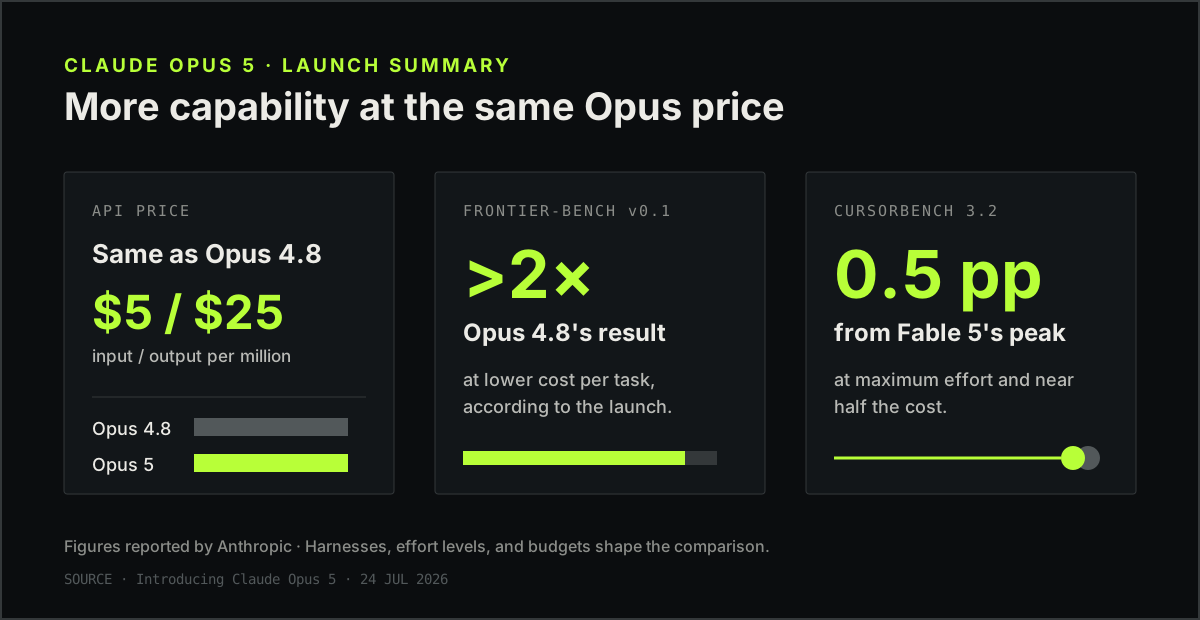
Benchmarks are useful here, with context. In Anthropic’s published evaluations, Opus 5 more than doubles Opus 4.8’s Frontier-Bench result at a lower cost per task. On CursorBench at maximum effort, it comes within half a percentage point of Fable 5’s peak score for roughly half the cost. It also leads the comparisons Anthropic shows for computer use and business automation. These are coherent signals of improved agentic work, but not a universal guarantee: several measurements come from the provider, use particular harnesses and budgets, and some allow another model to intervene when a safety classifier blocks a request.
More revealing than a single score are the failure modes Anthropic says it observed. In its examples, Opus 5 finds root causes where other models patch symptoms, builds auxiliary tools when it lacks a direct way to validate a result, and maintains the thread across large repository changes. Early-access reports also emphasize lower variance between runs and better judgment before publishing code. This remains launch evidence selected by the vendor, but it points to the right test for a team: not only how many problems the model solves, but how often it produces something verifiable without a person reconstructing the process.
The efficiency gain may be the more consequential change. Fable 5 remains Anthropic’s model for the longest and most autonomous projects, while Opus 5 tries to bring part of that capability into a price and latency range suitable for daily work. If that relationship holds outside the vendor’s benchmarks, the practical shift could matter more than a leaderboard gain: work that previously justified reserving the most expensive model may become good enough to integrate routinely into coding, analysis, and automation.
Anthropic also calls Opus 5 its most aligned model so far, reporting lower rates of deceptive or reckless behavior than Opus 4.8, Sonnet 5, and Fable 5. At the same time, it acknowledges that general capability improvements have strengthened the model on cybersecurity despite intentionally avoiding cyber-specific training, and it applies additional classifiers to some tasks. The tension is reasonable: an agent that is better at persisting, improvising, and recovering also needs boundaries that observe the full trajectory rather than each action in isolation.
My reading is that Opus 5 matters less because it displaces another model on a chart than because it narrows the distance between the best available performance and the performance that is practical to use often. The decisive question is whether its reported consistency survives untidy repositories, real tools, ambiguous requirements, and sessions lasting many hours. That is where an impressive demonstration becomes a dependable part of work.
Opus 5 is also available through Amazon Bedrock and other platforms, but that is distribution rather than the heart of the launch. Retention, residency, and control conditions differ by route and should be reviewed during deployment; first, though, it is worth understanding the model being distributed and why its combination of capability, cost, and autonomy deserves attention.
Sources
- Anthropic, Introducing Claude Opus 5, July 24, 2026.
- Anthropic, Claude Opus 5 System Card, July 2026.
- AWS, Claude Opus 5 is now available on AWS, July 24, 2026.