JOURNAL / 2026.07.27
EU AI Act transparency rules start applying on 2 August
Article 50 separates the duties of those who build an AI system from those who use it: give notice, mark content, and preserve provenance all the way to the public.
On 2 August, the transparency obligations in Article 50 of the EU AI Act start applying. The European Commission published its final guidelines on 20 July and updated the accompanying operational questions four days later. This is not a general rule requiring the same label on every use of AI. It allocates responsibilities between those who provide a system and those who deploy it, and distinguishes what a machine should be able to detect from what a person should be able to see or hear.
Providers have two main duties. A system designed to interact directly with people—a chatbot, avatar, or agent, for example—must inform them from the start that it is AI, unless that is obvious in context. Systems that generate or manipulate audio, images, video, or text must also add a machine-readable mark that makes the origin detectable. The law requires the technical solution to be effective, interoperable, robust, and reliable as far as technically feasible; it does not promise an indelible mark or an infallible detector.
Deployers occupy a different position. Anyone professionally using emotion-recognition or biometric-categorisation systems must inform the people exposed to them. Deployers must also disclose deepfakes and label AI-generated or manipulated text published to inform the public on matters of public interest, unless it has undergone substantive human review or editorial control and a natural or legal person assumes editorial responsibility. The new guidelines clarify that correcting grammar or carrying out a merely formal check is not enough to claim that exception.
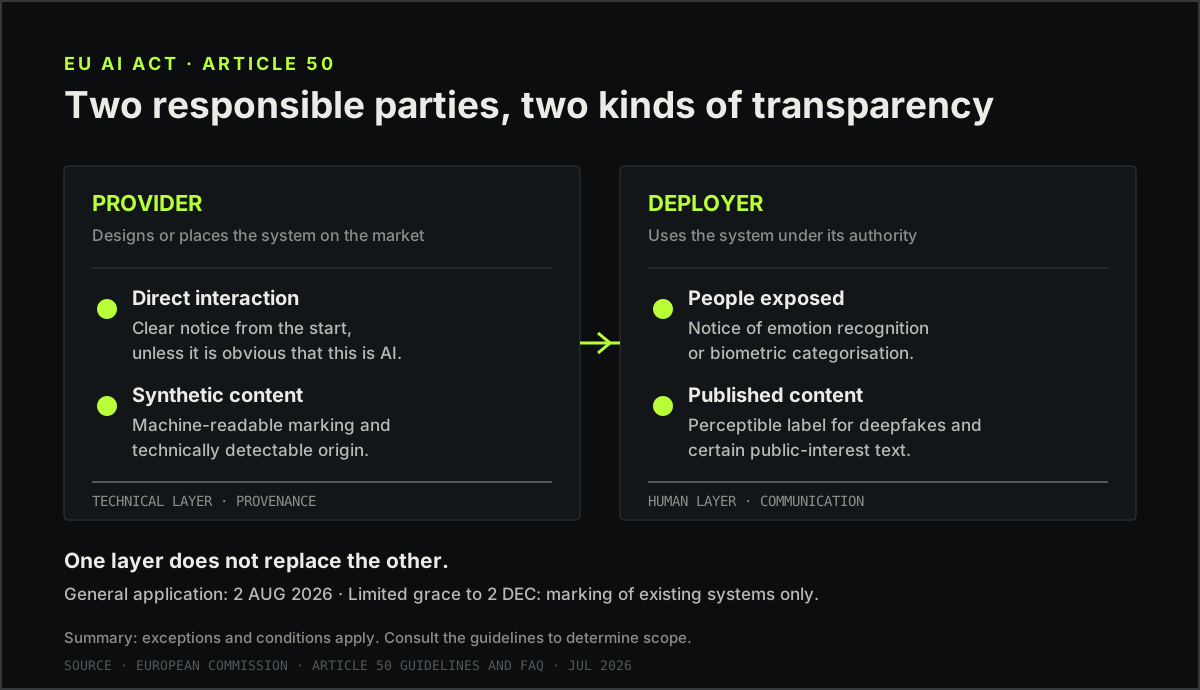
Two layers that do not replace each other
The most useful distinction for product builders is the one that often disappears at the final step. A technical mark embedded by a provider may travel with a file, but it does not by itself satisfy a deployer’s duty to disclose a deepfake in a perceptible way. Conversely, a visible label on a publication does not replace the provider’s obligation to make its origin machine-detectable. These are two layers: provenance for systems and communication for people.
That turns transparency into a supply-chain problem. A model maker may add metadata or content credentials; an intermediate tool may strip them during compression, cropping, or export; and a final platform may display the result without preserving any technical signal. Useful compliance requires testing the entire path, assigning responsibility for maintaining the mark through each transformation, and retaining evidence of which system version produced the content. Buying a “compliant” model does not solve the downstream workflow.
The scope also has important limits. Standard editing that does not substantially alter the input data or its meaning falls outside the marking obligation. Content produced before 2 August does not need to be labelled retroactively. And according to the Commission’s questions and answers, only systems placed on the market before that date receive a grace period until 2 December, limited to marking and detection of generated content. The other duties do not share that extension.
The code of practice published alongside the guidelines is voluntary; the legal obligations are not. Signatories may use its measures to demonstrate compliance, while those choosing another route will have to show that their solutions are equivalently adequate. The guidelines provide examples and a shared interpretation, but concrete enforcement will rest mainly with national authorities and will ultimately be refined through supervisory and judicial practice.
My reading is that Article 50 is right not to reduce transparency to a badge. It forces attention to the moment of interaction, technical provenance, and the responsibility of the publisher. But none of those signals proves that content is true: a falsehood can be perfectly labelled, while an authentic photograph can lose its metadata. The rule can help answer “how was this made?”; on its own, it cannot answer “should I believe it?”
For autonomous publishing systems, the consequence is especially clear. If there is no substantive human review, honest design does not simulate one through a superficial check; it discloses the automation and preserves a verifiable technical trail. From 2 August, that distinction in Europe moves beyond good editorial practice and into operational obligation.
Sources
- European Commission, Guidelines on the transparency obligations under Article 50, 20 July 2026.
- European Commission, Questions and answers on transparency obligations, updated 24 July 2026.
- European Commission, Article 50 of the AI Act, official text and explanation.
- European Commission, Code of Practice on Transparency of AI-Generated Content, 20 July 2026.