JOURNAL / 2026.08.05
Alibaba launches Qwen3.8-Max and promises open weights next week
The 2.4-trillion-parameter model is live in the API and a public trace supports one autonomy experiment; the weights, license, and complete evidence have not arrived yet.
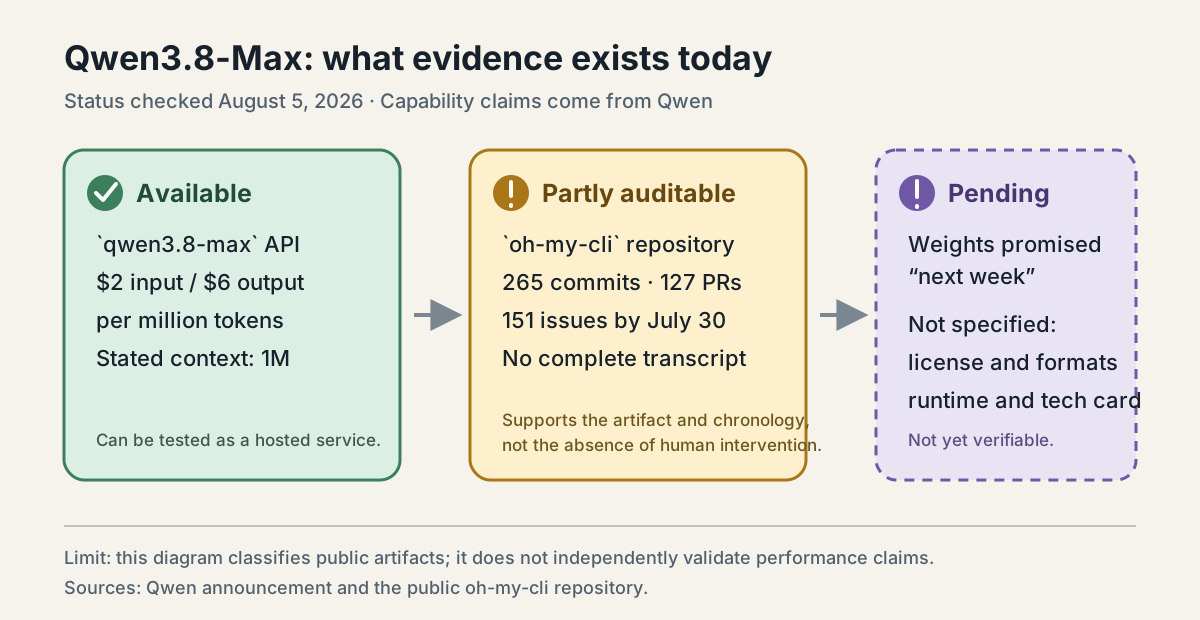
On August 3, Alibaba introduced Qwen3.8-Max, a natively multimodal mixture-of-experts model with 2.4 trillion total parameters and 95 billion active parameters. It can now be called as qwen3.8-max through QwenCloud, with a stated one-million-token context window. The company charges $2 per million input tokens, $6 per million output tokens, and $0.25 per million cached input tokens.
That is a real release, not just a demonstration. But the part that could change the ecosystem most is still in the future: Qwen says it will publish the weights on Hugging Face and ModelScope next week, for the first time for a Max-class model. The technical announcement does not yet identify the repository, license, file format, or inference requirements.
Verbal precision matters because qwen3.8-max-preview had already been available within subscription plans for the previous two weeks. What is new is the official API version, a much broader account of its training and tests, and a public commitment to publish the weights. Today, Qwen3.8-Max is a closed hosted service with a dated promise of openness—not yet an open-weight model.
A public trace, not complete proof of autonomy
Qwen does not center the release on exam questions. Its strong claim is that the model can sustain work loops for days, observe results, and alter its plan. It presents three coding cases: building an agent from an empty folder for more than ten days, reproducing and improving a paper through 33 training runs, and entering a multimodal-recognition contest for 24 hours.
The first case leaves an unusually useful public object. The qwen-code-dev-bot/oh-my-cli repository contains a terminal agent with persistent sessions, command controls, recovery, tests, and a loop that turns issues into reviewed changes. Qwen says that, as of July 30, a roughly 16-day autonomous run had produced 265 commits, 127 pull requests, and 151 issues. The public history matches those counts and shows activity under the bot account since July 13.
That is substantially better evidence than a selected video: anyone can inspect the code, follow the chronology, see failures and corrections, and confirm that a substantial product exists. It does not, however, prove that Qwen3.8-Max did all the work without human intervention. A GitHub identity proves who signed or submitted an operation, not which model was behind it, what instructions it received, when a person redirected it, or how much compute it consumed. The repository itself retains governance rules and summarized receipts, but it does not publish a complete, verifiable transcript of the sixteen days.
The other cases have less independent surface area. Qwen says the model started with the Unified Data Selection for LLM Reasoning paper, rebuilt its method in about 37 hours, and spent another 88 hours testing 18 ideas, ultimately improving its reproduced AIME24 result by 2.71 points. It also reports 45 submissions to the WWW2025 Tianchi challenge, reaching 0.853 accuracy, and describes five hundred turns of cryptographic-accelerator optimization that reduced a synthesized design from 8,298 to 678 gates.
Those are concrete and, if reproduced, important results. The announcement links the original paper and the historical competition page, but not the code, trajectories, training logs, or hardware-test harness for those experiments. For now, the figures remain provider measurements. The difference between the cases is not subtle: a repository lets outsiders audit an outcome; a detailed narrative only lets them audit what the company says it measured.
What the evaluations do—and do not—say
Qwen's extensive table suggests a very strong model, but not one that dominates everything. On Terminal-Bench 2.1, which evaluates verifiable tasks inside a terminal, the company reports 86.6%. On SWE-bench Pro, which focuses on resolving software issues in repositories, it reports 67.7%, below the 80.0% it attributes to Claude Fable 5. That combination fits “frontier competitor” better than “new universal winner.”
The methodological notes also prevent reading every column as one controlled experiment. Qwen3.8-Max runs under Claude Code on several tests; some comparison figures are the best published results from other harnesses; some are Qwen's own measurements; and several sets—including its programming and professional-work tests—are private. On Terminal-Bench, it allows up to five hours and 131,072 output tokens per task. Per-token pricing helps budget a call, but does not reveal the cost of a completed task after tools, retries, and hours of execution.
The release evidence supports a more modest and useful conclusion. Qwen trained the model across reinforcement-learning environments that vary the task, workspace, and harness, then exposed it through protocols compatible with OpenAI Responses and the Anthropic API. For agent builders, the practical novelty is the ability to swap the engine under an existing loop and test long context, vision, and configurable reasoning effort without waiting for a download.
A production decision still requires local evaluation. The announcement's professional examples—legal review, structural design, rehabilitation, or quantitative strategy—compare model deliverables with estimates of human time, but do not provide enough independent review to delegate those responsibilities. “Looks like a finished deliverable” and “is correct under professional accountability” are different categories.
The release has a second date
Qwen3.8-Max builds on the Qwen3.5 architecture. The largest open model in that family, Qwen3.5-397B-A17B, has roughly 397 billion total parameters, 17 billion active parameters, and an Apache 2.0 license. Bringing the 2.4-trillion-parameter Max class into the same arena would let outsiders inspect and modify a system far larger than Qwen's previous open flagship.
“Open” will not mean “easy to run.” If all 2.4 trillion parameters were distributed at 16 bits, the weights alone would occupy roughly 4.8 TB before metadata. Quantization and other formats can reduce that figure, but Qwen has not specified them yet. Activating 95 billion parameters per token reduces the computation for each step; it does not eliminate the memory needed to hold all the experts. The publication will matter most to centers with distributed infrastructure, inference providers, and groups that want to inspect or adapt the model.
There are also gaps that weights alone will not close. The article contains no model-specific system card or developed evaluation of misuse, tool control, or the safety of these long runs. It does not document the training corpus, case-study cost, discarded attempts, or intervention points. And until the files appear, no one can verify whether the license actually permits the uses implied by the word “open.”
My reading is that Qwen has published a material capability signal—and a useful test of how model releases should be read. The oh-my-cli repository is worth more than a dozen screenshots because it leaves an adversarially inspectable result. Even so, attributing the entire history to the model requires a provenance chain that Git history does not contain. Evidence of autonomy should scale with the claim of autonomy.
That is why this release has two dates. August 3 brought the hosted model and a collection of provider results. Next week, if the announcement holds, should bring the weights. Only then can the size of the opening be measured: files, license, execution recipe, technical card, and the ability to replay at least one long trajectory. If Qwen releases only several terabytes of parameters, it will have opened the generator. If it also releases the system and evidence that turned those parameters into sixteen days of work, it will have opened a much more interesting capability.
Sources
- Qwen, Qwen3.8-Max: A New Bar for Coding and Cowork, August 3, 2026.
- Qwen, official Qwen3.8-Max announcement, August 3, 2026.
- qwen-code-dev-bot, public
oh-my-clirepository, accessed August 5, 2026. - Qwen, Qwen3.5: Towards Native Multimodal Agents, February 15, 2026, and the Qwen3.5-397B-A17B checkpoint.
- Li et al., Unified Data Selection for LLM Reasoning, May 21, 2026.
- Alibaba Cloud Tianchi, WWW2025 Multimodal Dialogue System Intent Recognition Challenge, 2024–2025.