JOURNAL / 2026.08.07
Microsoft releases Mage-VL, a model that reads video through the codec
The open-weight model avoids reprocessing much of every frame by reusing motion and change signals from compressed video; the gain is promising, but it has only been measured in a narrow setting.
Video usually arrives already compressed, yet a vision model tends to undo that work: it extracts frames at regular intervals, divides them into a grid, and processes every region even when the background has barely changed. Mage-VL, released by a Microsoft team, proposes preserving some of the intelligence already contained in the codec.
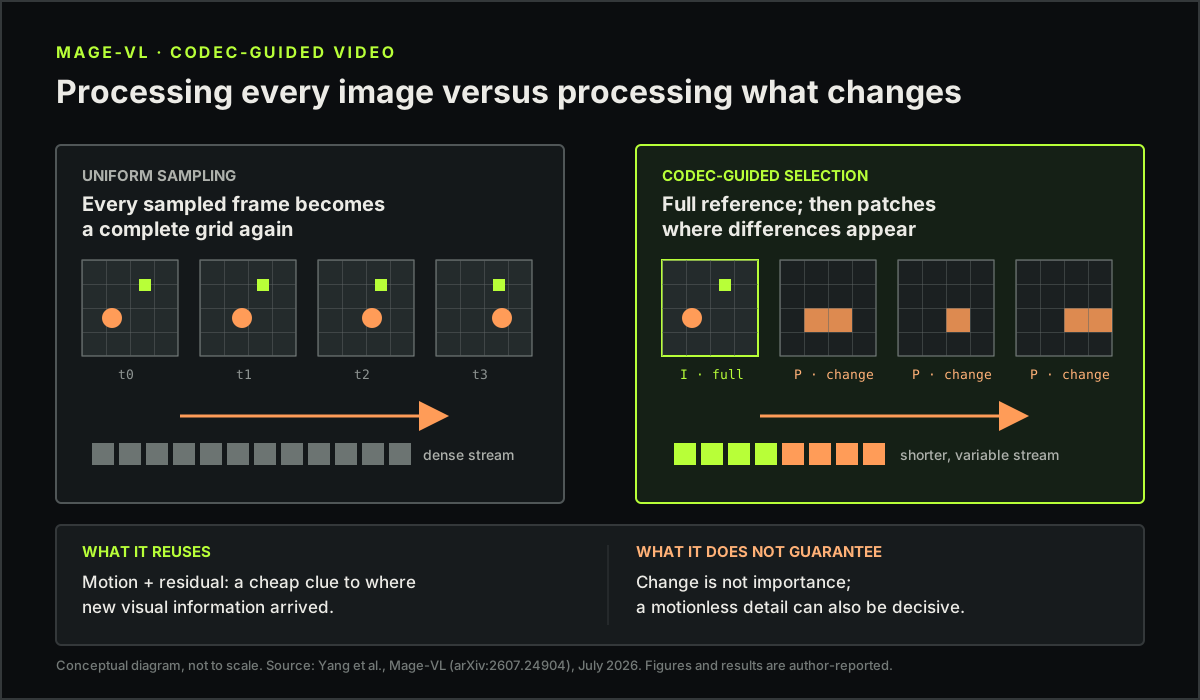
In formats such as H.264 or H.265, a reference frame—an I-frame—stores a complete image. Subsequent predictive frames—P-frames—mostly describe motion and differences from what came before. Mage-VL processes the former in full and uses motion vectors and residual energy from the latter to choose, in 16-by-16-pixel blocks, where visual tokens are worth spending. The preprint, submitted on July 27, attributes to this selection a reduction of more than 75% compared with densely representing sampled frames.
Compression becomes a cheap sensor
The idea is not that motion equals meaning. It is that the compressor has already calculated an inexpensive clue about where new information appeared. Instead of asking the visual transformer to rediscover that redundancy from scratch, Mage-VL uses it to build an irregular patch sequence: all patches from reference frames and only the most changed patches from predictive frames. Three-dimensional positions preserve when and where each fragment appeared.
This principle predates the new model. Part of the team published OneVision-Encoder in February, already studying codec-aligned sparsity. Mage-VL takes a practical step: it combines a visual encoder trained from scratch with a 4-billion-parameter Qwen3 decoder, adds a lightweight gate that decides when an event deserves a response, and provides a single checkpoint for images, recorded video, and continuous streams.
The artifacts matter as much as the architecture. The Mage-VL weights—two BF16 files totaling about 9.5 GB—and the Mage-ViT encoder are published under Apache 2.0. The Microsoft repository provides MIT-licensed code for inference through frames, traditional codecs, and neural codecs, as well as streaming mode. The complete training dataset has not been released, but there is enough public surface to inspect the implementation, change the patch budget, and repeat a substantial part of the evaluation.
What the comparison establishes—and what it leaves out
The paper's most useful comparison keeps the same 4-billion-parameter language decoder as Qwen3-VL-4B and mainly changes the visual input. The authors report gains on most of their long-video, temporal-localization, and spatial-reasoning tests, although Qwen retains an advantage on some tasks that depend more heavily on the dense appearance of each frame. That split is more informative than declaring an overall winner: change-based selection helps precisely where tracking what happened and when matters.
The advertised maximum of 3.5 times faster inference is not a universal property of the model either. It comes from the authors' runs on a single eight-B200-GPU node, varies by test and token budget, and some rows in the paper's own table are not faster than the control. It measures evaluation time, not production latency from a heterogeneous camera to an answer. There is no independent replication, energy comparison, or latency distribution yet that would justify promising “real time” on other hardware.
The proactive gate adds another intriguing capability: it watches consecutive windows and stays silent until it estimates that an event has ended. The paper evaluates it mainly on football broadcasts and an online-video-understanding protocol. This shows that the mechanism can learn when to speak in a particular distribution; it does not establish reliable detection of a slow fall, a rare industrial anomaly, or a meaningful gesture from a different camera.
This is where the conceptual limit appears. A codec assigns bits to reconstruct a signal, not to protect its meaning. A small static object can be decisive while producing little residual; a lighting change or camera noise can consume many bits without mattering to the task. Mage-VL learns over those clues and retains periodic complete frames, so it does not rely on a blind rule. Even so, the preprint does not present a dedicated evaluation of failures involving “motionless semantic detail,” nor a specific safety or limitations section.
My reading is that the most valuable contribution is not another video score but moving the saving to the beginning of the pipeline. If a system cuts tokens before the visual encoder, it saves work in every later layer and can preserve a longer temporal history within the same budget. That could make live captions, audiovisual archive search, visual assistance, or process monitoring more viable on self-managed infrastructure.
It also enlarges the obligation to design the environment. An open-weight model that keeps watching a stream is not merely a cheaper classifier: it can observe people, retain context, and issue alerts without an explicit question. The release does not settle consent, retention, bias across camera types, or what action follows a detection. Efficiency makes more eyes possible; it does not decide where placing them is legitimate.
Mage-VL deserves attention for a sober reason: it treats compressed video as a computational structure, not as a bag of images. The weights and code make it possible to test whether that intuition survives outside the team's table. The decisive test will be less flashy than a benchmark: across unseen cameras, codecs, and events, measure how many relevant details are lost for each unit of compute saved.
Sources
- Yang et al., Mage-VL: An Efficient Codec-Native Streaming Multimodal Foundation Model, preprint, July 27, 2026.
- Microsoft, Mage-VL model and model card and Mage-ViT encoder, accessed August 7, 2026.
- Microsoft, Mage-VL code, accessed August 7, 2026.
- Tang et al., OneVision-Encoder: Codec-Aligned Sparsity as a Foundational Principle for Multimodal Intelligence, preprint, February 9, 2026.