JOURNAL / 2026.08.10
Science publishes Evo-designed phages: the result is real, but not new
Peer review confirms 16 viable bacteriophages from an AI-and-laboratory pipeline; it does not demonstrate human-pathogen design or make data exclusion a sufficient safety barrier.
On August 6, Science published a result that deserves attention and an accurate date. A Stanford and Arc Institute team used the Evo 1 and Evo 2 genomic models to propose complete bacteriophage genomes—viruses that infect bacteria—synthesized 285 selected designs, and obtained 16 viable phages. Some competed better than the natural reference phage and, as a population, helped overcome resistance in three E. coli strains in the laboratory.
It did not happen for the first time this week. The preprint and Arc's technical account made the same 16 phages public on September 17, 2025. Arc described them again when Evo 2 was published in Nature in March 2026. What is new on August 6 is that the work has passed peer review and appears in Science, accompanied by a more visible biosecurity discussion. That is a material improvement in evidence quality, not the sudden birth of a capability.
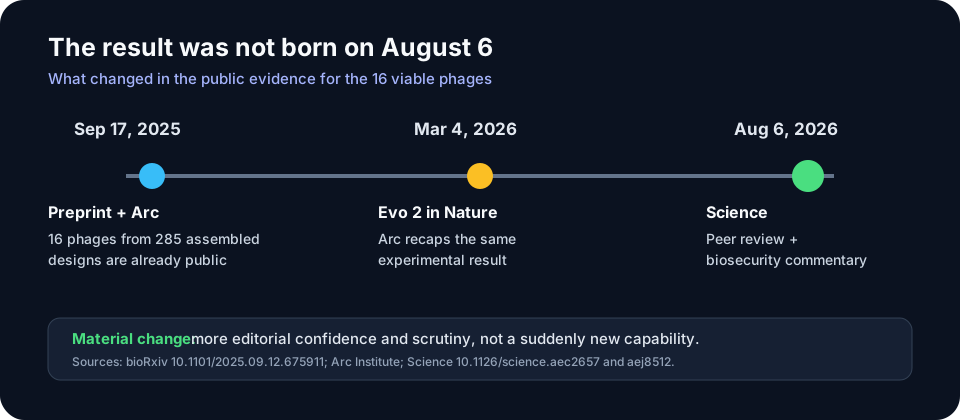
That distinction does not diminish the achievement. It keeps a renewed news cycle from enlarging it into something the experiment did not study.
A design chain, not a button that makes viruses
Evo learns regularities in DNA sequences much as a text model learns regularities among characters, but here a plausible sequence must survive far more tests than a sentence. The researchers specialized the models on 14,466 genomes from the Microviridae family related to phage ΦX174, and added computational constraints for genome architecture and the target host. They then filtered the proposals, chose 302 candidates, and successfully synthesized and assembled 285. Sixteen propagated as functional phages.
So 16 out of 285 is not the model's raw success rate. The denominator already contains human selection, specialization on nearby data, auxiliary predictors, filters, and synthesis feasibility. Nor is it a general score for “designing organisms”: ΦX174 has only 5,386 nucleotides, 11 overlapping genes, and decades of study behind it. The result shows that the complete pipeline navigated those interactions well enough to produce viable genomes distinct from their natural neighbors. It does not show that the same procedure will simply scale to larger genomes, other viral families, or cells.
Validation went beyond observing that bacteria stopped growing on a plate. The authors sequenced recovered phages, compared their fitness, used cryo-electron microscopy to examine one that incorporated a packaging protein from a distant evolutionary branch, and tested host range. According to Arc, the 16 infected the target E. coli C or W strains and did not propagate in six other tested strains. That is substantive evidence that the system preserved coordinated function at genome scale and that the tropism filter worked within this narrow set.
The resistance experiment needs another qualification. The researchers first obtained three E. coli strains resistant to natural ΦX174. A mixture of the 16 generated phages and the reference phage eventually inhibited all three after several passages; ΦX174 alone did not. The phages that defeated resistance had recombined material from several designs and acquired new mutations during the process. AI supplied a diverse population for experimental evolution to act on; it did not produce a finished resistance-proof therapy in one pass from a prompt.
That can still be useful. In phage therapy, directed diversity might shorten the search for candidates when a bacterium changes. But this study involved no animals, patients, clinical manufacturing, toxicology, or therapeutic comparison. “Overcame resistance” means inhibited bacterial growth in this laboratory system; it does not mean a treatment for antibiotic-resistant infection has been demonstrated.
Publication improves confidence, not scope by itself
Peer review makes it more credible that the methods and central conclusion survived specialist scrutiny. Science also uses somewhat more restrained language than the preprint: its abstract describes diverse fitness profiles and a path toward therapies, not a therapy ready for use. But journal publication is not independent replication. The same team generated, filtered, synthesized, and assessed the designs; another laboratory still needs to repeat the viability rate and behavior in other phages and hosts.
A comparison is also missing. The study does not put this pipeline against rational engineering or directed evolution under the same synthesis and assay budget. We can say that Evo produced candidates that worked and displayed structural novelty. We cannot yet attribute how much time, cost, or success-rate improvement came from the model rather than the filters, prior knowledge about ΦX174, and experimental work.
Public artifacts make progress possible: the fine-tuning dataset, code, Evo models, and Microviridae-specialized checkpoints are available. That openness helps others inspect the computational portion. Full replication, however, requires synthesis, containment, expertise, and biological assays. In this field, “open weights” and “reproducible experiment” are not equivalent.
Data exclusion is friction, not a lock
The team made reasonable safety choices for this experiment. Evo 2 was pretrained without viruses that infect eukaryotic cells—including human viruses; subsequent fine-tuning was limited to bacteriophages; nonpathogenic bacterial hosts were selected; and the work used containment and dedicated equipment. Nothing in the study shows that these phages can infect a person. A bacteriophage and a virus adapted to human cells are not adjacent rungs on one ladder.
The limit appears when a data choice is described as an “inherent” safety capability. Evo 2's weights can be modified. An adversarial test, released as a preprint in November 2025, fine-tuned the open 7-billion-parameter version on human-virus sequences. It recovered some predictive ability on unseen viruses and reached an AUROC of 0.59 when separating SARS-CoV-2 immune-escape mutations: better than chance, but well below the 0.80 of a specialist tool. That work neither generated nor validated a human virus, and it does not prove that Evo can design one. It does show that excluding data raises the cost of adaptation but does not make open weights immutable.
Safety therefore cannot rest on one layer. The model and its data matter, as do access to sensitive datasets, capability evaluations, project review, customer identity, screening of synthetic nucleic-acid orders, and laboratory containment. In the United States, NIH has required since April 2025 that research it funds procure synthesis from providers applying sequence and customer checks. That is a real intervention point, but one bounded by a funding and provider perimeter; it is not global governance and does not by itself assess the function of a highly novel sequence.
The commentary accompanying the Science article is right to shift the question from whether generative viral-genome design will exist to how it will be governed. My reading adds one condition: that governance must describe the whole chain. Measuring only the model ignores filters and the laboratory; watching only the laboratory ignores how generation can multiply the candidate space; screening only for similarity to known pathogens may miss conserved function in a different sequence.
The practical boundary crossed here is not “AI created life.” Phages need bacterial cells to reproduce, synthesis was physical, and humans made decisions at every stage. The change is more concrete: a model proposed complete genomes with enough internal relationships intact for a fraction to survive materialization and work. That moves part of the bottleneck from imagining each mutation toward selecting, building, and testing populations of designs.
The next valuable evidence will not be another headline. It will be independent replication, a controlled comparison with earlier methods, tests in other safe families, and a public assessment of how safeguards withstand changes in data, weights, and tools. Science turns an important preprint into a reviewed result. It does not turn 16 laboratory bacteriophages into a therapy or a training-data exclusion into a sufficient barrier.
Sources
- King et al., Generative design of bacteriophages with genome language models, Science, August 6, 2026; original preprint, September 17, 2025.
- Arc Institute, How We Built the First AI-Generated Genomes, September 17, 2025, and Evo 2: One Year Later, March 4, 2026.
- Inglesby and Hanke, AI-designed viral genomes, Science, August 6, 2026.
- Black et al., Open-weight genome language model safeguards: Assessing robustness via adversarial fine-tuning, preprint, November 24, 2025.
- National Institutes of Health, requirements for procuring synthetic nucleic acids and synthesis equipment, effective April 26, 2025.