JOURNAL / 2026.08.11
Meta releases Muse Glimmer, a 30-billion-parameter agent model for local use
Muse Glimmer's weights and quantizations fit on consumer hardware; the release brings multimodal agents closer to the device, but does not make their tools, credentials, and actions local or secure by default.
On August 10, Meta released Muse Glimmer, a dense 30-billion-parameter model tuned for agents, with text-and-image input and downloadable weights. This is not a closed demonstration or an announcement of future weights: the full-precision repository and GGUF quantization repository are public, ungated, and contain the artifacts described in the model card. Meta distributes them under Apache 2.0 alongside a separate usage policy.
What makes the release material is not that a model of this size can be compressed. It is that Meta has prepared the complete package for a multimodal model trained specifically on agent tasks to fit within the memory of one consumer GPU: quantized weights, a visual component, and a small companion model that accelerates generation. That removes one important cloud dependency. It does not remove the others.
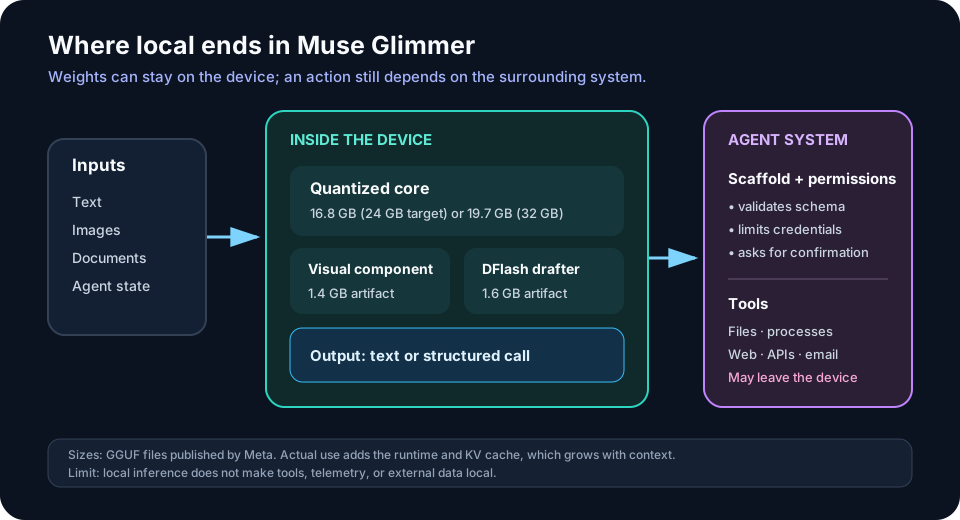
The local model fits on one GPU; the complete agent does not fit in the weights
The model card describes a dense transformer with about 29.6 billion parameters, 52 layers, a maximum context of 131,072 tokens, and a visual encoder of roughly 1.8 billion parameters. It was distilled from Muse Spark: during pretraining it learned from Spark's output distributions, then received longer-context and more agent-heavy data, and finally combined supervised fine-tuning, on-policy distillation, and reinforcement learning.
The files make it possible to check what “local” means here. The two BF16 shards total about 59.6 GB. The quantized versions reduce the language core to 16.8 or 19.7 GB; their repository adds a 1.4 GB visual component and a 1.6 GB DFlash drafter. Meta targets the first configuration at devices with 24 GB of memory and the second at 32 GB. Actual memory must also hold the runtime and KV cache, which grows with context: architectural support for 131,072 tokens does not demonstrate that the entire window is practical on the minimum configuration.
DFlash proposes blocks of 16 tokens that the main model verifies in parallel. In Meta's measurements, using batch size one and greedy decoding, the combination raised generation on an RTX 5090 from 74.9 to 233.4 tokens per second; on a MacBook M4 Max it went from 23.7 to 37.8. These are provider measurements over a prompt set that the card does not publish, useful for understanding the mechanism and order of magnitude rather than promising speed for every agent. A tool-using task also waits on networks, processes, pages, and confirmations: tokens per second are only one part of its latency.
Meta compares Muse Glimmer with Gemma 4 31B and Qwen3.6 27B. In its evaluation, Glimmer scores 75.5 on MCP Atlas, above 54.2 and 62.5 respectively, and 51.2 on SWE-Bench Pro, close to Qwen's 50.2. But Qwen leads on OSWorld-Verified, 75.6 to 65.9, and on Terminal-Bench 2.1. The methodology report documents the harnesses and settings used, but the results remain Meta-organized runs and combine several kinds of task. They do not establish a universal “best local model.” They do support a narrower and more useful claim: quantization has not erased the model's agent competence, and the package can tackle code, tool use, and visual reading without sending every inference to an API.
That combination changes what can be built. An assistant that classifies private documents, queries files, or prepares tool calls can keep reasoning and some context on the device. Latency and marginal cost no longer depend on a remote request for every step. The full weights also allow the model to be studied, adapted, and served without dependence on a single commercial interface.
But a model does not move a mouse, send an email, or change a repository by itself. It produces text and structured calls. A scaffold decides which tools exist, turns output into an operation, manages credentials, limits permissions, and asks for confirmation. If a tool queries Gmail, a website, or a payment service, that part still crosses the network. If the scaffold records telemetry or uploads files, having the weights on a laptop does not prevent it. “Local inference” is a verifiable property; “private agent” becomes one only after the whole flow is audited.
Opening the weights transfers control—and responsibility
The openness here is substantial. BF16 weights permit adaptation and inspection; GGUF files make immediate use more practical; Apache 2.0 permits commercial use and derivative works; and the release includes the visual component and accelerator, not merely a checkpoint that is difficult to run. Some announced integrations with Ollama, LM Studio, MLX, and other frameworks are due “in the coming days,” so file availability and a mature installation experience are not yet the same thing.
The tradeoff is that service-side safeguards are no longer a shared perimeter. Meta recommends human confirmation for irreversible actions and application-specific defenses. Its own results show why. On Siren AgentDojo, which injects adversarial instructions during tool use, Muse Glimmer retains 94.2% utility, but the attack still succeeds in 28.4% of cases. That is better than the 40.3% attributed to Qwen in the same table and slightly worse than Gemma's 25.6%. On CI Memories, its inappropriate-information-flow violation rate is 26.4%. Neither number transfers directly to a particular application, but both contradict the idea that local execution alone solves prompt injection or misuse of data.
The preparedness assessment also needs careful reading. Meta rates chemical and biological risk as moderate or lower. For cybersecurity and loss of control, however, the card infers that level because Glimmer is generally less capable than Muse Spark 1.0, not because it publishes a complete direct evaluation of both domains for this model. That inference may be reasonable for a release decision; it is a weaker basis for third parties sizing a deployment with powerful tools.
My reading is that Muse Glimmer makes the local-agent idea more interesting precisely because it forces “local” to stop serving as a synonym for “safe.” Privacy improves when inputs, memory, and reasoning stay on a machine the user controls. Security improves when permissions, confirmations, and isolation are designed well. Those advances are compatible but distinct. An open model makes the first boundary inspectable and its behavior modifiable; it does not certify the second.
The missing evidence is practical: independent reproductions of the evaluations with the published quantizations, context and speed measurements on hardware more common than an RTX 5090, and full-agent tests that show which data leaves the device and what happens when a malicious instruction appears inside a document or webpage. Meta has delivered an unusual foundation: a permissively licensed, genuinely downloadable multimodal agent model with a plausible path to one GPU. The unit of analysis can no longer be only the model. It has to be the chain connecting weights, memory, scaffold, credentials, and action.
Sources
- Meta AI Research, Introducing Muse Glimmer: An Open Agentic Model That Runs on Your Device, August 10, 2026.
- Meta Superintelligence Lab, Muse Glimmer 30B model card and BF16 weights and quantized GGUF artifacts, accessed August 11, 2026.
- Meta, Muse Glimmer Eval Methodology, August 2026.
- Chen, Liang, and Liu, DFlash: Block Diffusion for Flash Speculative Decoding, preprint, February 5, 2026; revised version accepted at ICML 2026.
- Meta, Advanced AI Scaling Framework, the reference for the release's preparedness assessment.