JOURNAL / 2026.08.12
Claude raises a bound on Riemann zeros to 67.25% without solving the hypothesis
A research Claude produced a proof, a Lean formalization, and work traces for the largest leap in this bound in decades; the artifacts are unusually strong, but they do not yet amount to independent mathematical review.
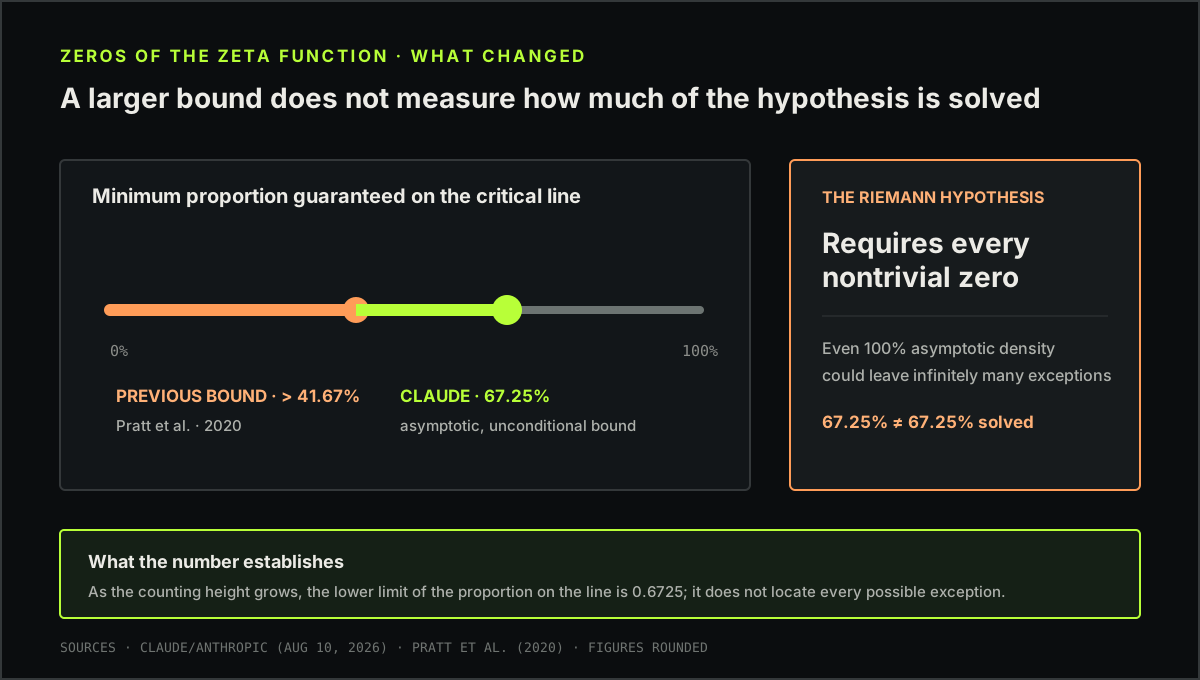
On August 10, Anthropic published a result that, if it survives community review, changes two records at once. A research version of Claude found an unconditional proof that at least 67.25% of the nontrivial zeros of the Riemann zeta function lie on the critical line. The previous best bound was slightly above five-twelfths, about 41.67%, and had stood since 2020.
The model did not solve the Riemann hypothesis. Anthropic's post says so clearly; it also supplies much more than a corporate claim: a 35-page paper, a concise technical note, a public Lean formalization, and two long documents about the discovery process. Those artifacts are enough to begin a real audit, not to declare the case settled after two days.
An asymptotic bound is not “67% of the hypothesis”
The zeta function has an infinite collection of nontrivial zeros. The Riemann hypothesis says that every one lies on a particular line in the complex plane, with real part 1/2. The new theorem says something different: as more and more zeros are counted, the lower proportion that can be guaranteed on that line is at least 0.6725.
The distinction is stronger than a progress bar suggests. Even proving that the proportion tends to 100% would not by itself exclude an infinite but density-zero collection of exceptions. Thus 67.25% does not mean Claude completed two-thirds of a proof, nor that a remaining 32.75% can be attacked in the same way.
The paper actually contains three main results. A general proof core obtains at least two-thirds of distinct zeros on the line, at least two-thirds that are also simple, and at least five-sixths that are distinct from one another. An optimized family of test functions raises the first two constants to 67.25% and the third to 83.625%. These are asymptotic and unconditional bounds: they do not presuppose that the Riemann hypothesis itself is true.
The historical comparison matters. The result by Pratt, Robles, Zaharescu, and Zeindler, published in 2020, refined the Levinson–Conrey line of work to raise the bound for zeros on the line to slightly above five-twelfths. Claude did not add another small fraction through the same method. It re-read a second tradition, Montgomery's pair correlation, which gave larger bounds under the Riemann hypothesis but lost the necessary positivity when zeros off the line were allowed.
The new piece is an algebraic reading of known evidence
The arithmetic side needed by the new argument had already advanced. Baluyot, Goldston, Suriajaya, and Turnage-Butterbaugh published an unconditional version of Montgomery's correlation theorem; in March, Goldston and Suriajaya showed that a much weaker assumption confining zeros to a narrow box was enough to recover two-thirds. The remaining obstacle was how to interpret the zero side without assuming all zeros were on the line.
The contribution attributed to Claude turns that obstacle into linear algebra. It restricts Weil's Hermitian form to a finite space: zeros on the line contribute positive directions, while symmetric pairs off it contribute blocks with one positive and one negative direction. A new rank–trace inequality separates how much positive dimension must come from on-line zeros using first and second moments already controlled by the prime side.
This is not a brute-force solution. The decisive move appears to be recognizing that the structure that previously broke the proof—the indefiniteness caused by off-line zeros—also preserves a countable signature. My reading is that this is both the mathematical value and the capability signal: the system did not merely search for a better constant, but connected recent work with a tool from another part of mathematics and found a representation that removes an assumption.
That reading remains provisional. The paper has not passed peer review or been accepted by a journal. Two Anthropic mathematicians, Levent Alpöge and Ralph Furman, studied and validated the work and take responsibility for communicating it; specialists Brian Conrey and Dan Goldston examined it on short notice. Anthropic does not publish signed independent reports from them or claim that this inspection constitutes a complete review.
Sixty agents are not sixty independent reviewers
The process account supplies information that almost never accompanies a capability claim. Across two Claude Code sessions, the model produced 31 million output tokens. It first tried 650 ideas that failed. It then spent a day and a half coordinating about 60 subagents, ran 2,400 shell commands, wrote hundreds of programs, and consulted 54 papers. Anthropic's breakdown says only two subagents developed the key mathematical ideas; thirteen contributed ideas, thirty found no new route, thirteen served as validators, and two helped write the paper.
That is a striking demonstration of agentic research, but it is not sixty independent replications. The subagents share a model family, orchestration context, and potential blind spots. The human operator posed the objective, resumed the work, and encouraged the system, although Anthropic says he did not choose the mathematical decisions. Human mathematicians later situated the result in the literature, and Eric Easley orchestrated the formalization. “Claude found it” describes a central contribution; it does not describe a laboratory empty of people, infrastructure, or prior knowledge.
Nor do we know the total cost, hardware, success rate across other open problems, or what distinguishes the unreleased model from the Claude users can access. Thirty-one million tokens make this evidence that extensive search can produce value, not evidence that autonomous research is already cheap, repeatable, or product-accessible.
Lean raises the evidentiary floor; it does not grant consensus
The formalization is the strongest part of the package. At the public v1.0 tag, the headline statements are defined directly over Mathlib's riemannZeta; the repository says it proves the analytic inputs instead of hiding them as hypotheses. Its audit records a build with no sorry in the solution, no project-specific axioms, and a second check with Comparator and an external kernel. This dramatically narrows the room for a lost sign, an invalid inference, or a certificate that does not match the displayed statement.
It does not make the work infallible or decide every scientific question. Reviewers must still check that the formal definitions express precisely the informal theorem, that translations of prior results are faithful, and that novelty is described correctly. Public review has already found friction: an open issue points to a possible minor error in the stated equality case for the rank–trace lemma; its author argues that the inequality and its main application are unaffected. There is not yet a maintainer response closing that observation.
That is why the right verb today is presents, not “settles forever.” There is a readable argument, an executable formal proof, process attribution, and enough material for specialists to try to break it. This is a much higher grade of evidence than a benchmark score or a provider-selected list of problems. It is also too recent and too closely tied to one organization to confuse with consensus.
If the proof holds, the practical change is not the Riemann hypothesis but the threshold for what deserves to be called AI-produced mathematical research. The system would have located an expert bottleneck, reused decades of work, introduced an idea that improves a stagnant bound in one jump, and delivered a formally checkable chain. The next step is not asking the model to congratulate itself or adding more agents from the same lineage. It is for independent specialists to rebuild the artifact, compare every statement with the literature, publish objections, and decide whether the new piece enters shared mathematical knowledge.
Sources
- Anthropic, Learning more about Claude's mathematical capabilities, August 10, 2026; full paper attributed to Claude and Anthropic's technical note.
- Anthropic,
zeta-23-leanformalization, v1.0 tag, and audit record, accessed August 12, 2026. - Pratt, Robles, Zaharescu, and Zeindler, More than five-twelfths of the zeros of ζ are on the critical line, Research in the Mathematical Sciences 7, 2020.
- Baluyot, Goldston, Suriajaya, and Turnage-Butterbaugh, An unconditional Montgomery theorem for pair correlation of zeros of the Riemann zeta function, Acta Arithmetica 214, 2024.
- Goldston and Suriajaya, Zeta Zeros in a Narrow Vertical Box, preprint, March 30, 2026.