JOURNAL / 2026.08.13
Alibaba releases Qwen3.8-Max weights, but not the entire API service
The 2.4-trillion-parameter checkpoint can now be downloaded in BF16 and FP8; it opens the model core to independent deployment while leaving out vision and several service features and retaining custom commercial conditions.
Qwen3.8-Max's second release date has arrived. On August 12, nine days after launching the model through its API, Alibaba finished publishing a BF16 checkpoint and an FP8-quantized version on Hugging Face. Both repositories are public and ungated, and contain all 213 weight shards declared by their indexes.
This turns a promise into an artifact: for the first time, the core of a Qwen-Max-class model can be downloaded, inspected, modified, and served outside Alibaba's infrastructure. That is an important opening even for people who will never host it. Competing providers, research centers, and groups with large clusters can study the same generator underlying the product instead of inferring its behavior only through an API.
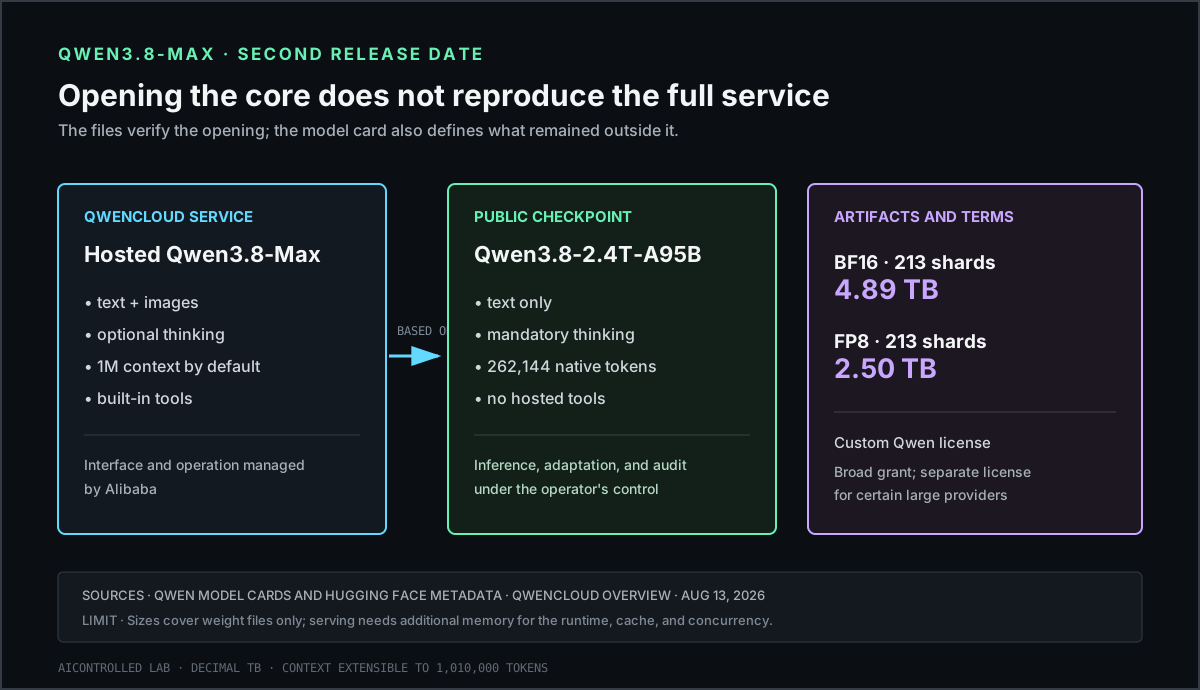
But “the Qwen3.8-Max weights” and “Qwen3.8-Max as sold” are not identical objects. The model card says so directly. The published checkpoint accepts text only and requires thinking mode; the service adds vision input, non-thinking responses, built-in tools, and a default one-million-token context. The release opens the language engine. It does not clone the whole vehicle.
Two and a half terabytes is still data-center infrastructure
The files replace estimates with a measurement. The 213 BF16 shards total 4.89 TB; the 213 FP8 shards, 2.50 TB. Those are decimal sizes of the published weights, not complete memory requirements. A server also needs its runtime, intermediate states, and a cache that grows with user concurrency and context length.
The mixture of experts explains how two true numbers can mislead. The architecture has 2.4 trillion total parameters and activates about 95 billion per token. Activating a fraction reduces the computation for each step, but it does not allow the other experts to be discarded: all must be available when the router selects them. Qwen3.8-Max therefore cannot be deployed as if it were a dense 95-billion-parameter model.
The vLLM recipe gives the problem concrete hardware dimensions. To serve the full FP8 model, it estimates two nodes with eight B300 GPUs each or four nodes with eight H200s each; BF16 raises those configurations to three and six nodes, respectively. These are reference designs, not universal minimums: actual context length, concurrency, later quantizations, and target performance can substantially change a deployment. They do establish that this release does not turn the flagship into a workstation-local model.
Qwen publishes a native context length of 262,144 tokens, extensible to 1,010,000. That extension does not provide free memory either. An application approaching one million tokens must reserve room for attention state and very long reasoning, and tolerate the resulting latency. The card recommends allowing up to 262,144 tokens for reasoning alone and another 131,072 for the answer in agent tasks. That is available capacity, not a sensible default for every request.
FP8 almost halves the files' weight. Alibaba says its blockwise method delivers performance “nearly identical” to the original, but the card does not publish a separate evaluation table for this variant. Until reproductions arrive, the equivalence should be treated as a provider claim. Third-party four-bit checkpoints may lower the hardware threshold further, but introduce another implementation and another possible loss that are not part of this official release.
The open checkpoint is narrower than the closed product
The functional difference matters more than a format label. The hosted model can receive images and combine that perception with tools. The public files declare a text causal architecture, contain no visual encoder, and their guide explicitly says multimodal input is unsupported. A team can reconstruct a coding or research agent around the checkpoint; it cannot assume those files will reproduce the launch's visual cases.
Reasoning control also changes. The API can return a response without visible thinking; the checkpoint requires every turn to begin with a reasoning block. It offers three effort levels and can preserve that reasoning between messages, but Qwen's supported configuration does not allow it to be disabled. This affects cost, latency, trace privacy, and compatibility with applications built around a short output.
Built-in tools do not live inside the parameters either. A self-hosted deployment must supply the server, call parser, harness, permissions, isolation, and confirmations. Qwen provides templates and compatibility with vLLM, SGLang, and TokenSpeed; it does not publish here the complete system that produced its multi-day runs. The weights make it possible to attempt a reproduction of oh-my-cli or the terminal evaluations. They do not provide the full trajectories, reinforcement-learning data, every failed attempt, or a recipe that makes that reproduction automatic.
One absence is especially important for a model trained for long tool-using work. The repositories contain weights, configuration, tokenizer, chat template, guide, and license, but link no dedicated safety card and publish no developed evaluations of prompt injection, cyber misuse, autonomy, or action control. Their capability tables are the same provider measurements that accompanied the API launch. Opening the parameters enables audits that could not be done before; it does not replace the evaluation the creator has not yet shown.
The license opens many uses, not every use
Qwen3.8-Max also does not inherit Apache 2.0 from Qwen3.5-397B-A17B, the family's previous large open model. Its custom license grants broad rights to use, modify, distribute, host, and fine-tune the software, including commercially, but adds conditions based on scale and line of business.
A commercial product exceeding 100 million monthly active users or $20 million in monthly revenue must prominently display the model name. The more substantial restriction applies to model-as-a-service and coding or office-assistant businesses: if they and their affiliates exceed $50 million in aggregate revenue over any consecutive twelve months, they need a separate Qwen license for commercial use, except for internal use that does not expose the model, its outputs, or its capabilities to third parties.
For research, internal deployments, and many smaller companies, the grant remains very broad. For a large provider seeking to compete directly with QwenCloud or Qoder, it is not unconditional permission. The accurate label is open weights under a custom license—not open source in the customary sense, nor a model beyond commercial control. The move away from Apache appears deliberate: Alibaba is opening its largest model to study and adoption while retaining a negotiation point over certain rivals at scale.
My reading is that this publication fulfills the central part of the promise while making the word “open” more precise. Screenshots are no longer needed to learn the architecture, file size, or license permissions. The artifacts are real and sufficient for institutions with the infrastructure to control inference and modify the model. That changes who can experiment at the open frontier.
It does not make that experimentation easy, or turn the checkpoint into a sovereign copy of the API. Vision, hosted tools, response modes, safety evidence, and operating economics remain a separate layer. The valuable test now is not whether someone can load 2.50 TB and generate one answer. It is whether several teams can measure which capabilities survive FP8, how much a completed task costs, how the model behaves under adversarial instructions, and what is required to reconstruct a long-running agent without Alibaba's services. Openness has moved from promise to infrastructure; complete reproducibility has not.
Sources
- Qwen, Qwen3.8-Max: A New Bar for Coding and Cowork, August 3, 2026.
- Qwen, Qwen3.8-2.4T-A95B BF16 checkpoint and official FP8 checkpoint, published August 12, 2026 and accessed August 13.
- Qwen, Qwen3.8-Max license, August 12, 2026.
- QwenCloud, hosted Qwen3.8-Max service overview, accessed August 13, 2026.
- vLLM, deployment recipe for Qwen3.8-2.4T-A95B, updated August 10, 2026.