JOURNAL / 2026.08.19
GLM-5.3 improves at cybersecurity, but Z.ai delays its weights
The new model is already live through an API and advances sharply from finding flaws toward exploitation; Z.ai promises weights after a two-week review without yet publishing the criterion that will determine whether they are ready.
Z.ai has made two releases with one date. Since August 14, GLM-5.3 has been usable through its API and coding-agent plan. The weights, by contrast, will arrive “two weeks after launch,” once safety evaluation and hardening are complete. As of today, they do not appear in Z.ai’s official Hugging Face organization.
The separation matters because the capability is already circulating, but remains under provider control. A team can incorporate the model into an agent, give it a terminal and tools, and send it real code. It cannot yet run the model offline, inspect the released artifact, modify its safeguards, or test whether the service and the future checkpoint behave alike.
The stated reason for the delay is also the main new development. Z.ai deliberately trained the model on vulnerability-discovery data and environments. Improvement was greater than expected as it moved from locating flaws toward constructing exploitation chains, and the company calls this an “emergent cyber capability.” There is evidence of a substantial jump over GLM-5.2. There is no evidence that it has generally surpassed closed frontier models, and “emergent” does not mean that the skill appeared without training.
The same base model learned different work
According to the GLM-5.3 technical documentation, its base is the same as GLM-5.2: all the improvement comes from post-training. Z.ai expanded executable reinforcement-learning environments to represent longer units of work. One internal example gives the agent code, documentation, storage, experimental results, and compute access; it must locate a bottleneck, change the system, run experiments, and demonstrate an improvement without breaking correctness.
The mechanism for creating this practice also uses agents. Some extract patterns from real work and synthesize environments with hidden state; another attempts to solve them; verifiers are generated without seeing the reference solution and tested against correct answers, unsolved states, and no-op actions. The method aims to scale something valuable: tasks that can be executed and graded, not merely answers another model finds plausible. Z.ai acknowledges that the process still requires meaningful human involvement and does not publish the private environments or a measure of how many faulty verifiers were rejected.
On the private Z.ai Code Bench, the maximum-effort setting rises from 23.4% with GLM-5.2 to 34.5% with GLM-5.3 while reducing approximate output per task from 96,000 to 75,000 tokens. This is the source of the announcement’s “50% better”: it is a relative improvement on an internal evaluation, not fifty percentage points or a guaranteed speedup in every repository. Public terminal and agent tests move in the same direction, but their results depend on the harness, budget, and exact dataset version.
For someone building today, the change is concrete. GLM-5.3 accepts text only, has an advertised one-million-token context window, can output up to 128,000 tokens, and keeps reasoning permanently enabled with three effort levels. API pricing remains at GLM-5.2’s $1.40 per million input tokens and $4.40 per million output tokens. A large context window permits more state to be loaded; it does not establish that the model uses all of it well throughout a run, and cost per task will still include tools, retries, and review.
Finding, developing, and completing an attack are not the same test
The most widely repeated number is 84.5% on CyberGym, slightly above the 83.8% Z.ai reports for Mythos 5 and GPT-5.6 Sol’s 83.6%. CyberGym starts from source code and descriptions of real vulnerabilities; the agent must produce a test that triggers the bug. It is a useful measure of white-box reproduction and validation. It is not the same as finding an unknown flaw in an arbitrary project or turning it into arbitrary access.
The announcement’s other two tests rule out the comfortable headline that GLM-5.3 “beats the frontier.” On ExploitBench, which starts from a known patch and scores rungs from reaching vulnerable code through arbitrary code execution, GLM-5.3 scores 54.4%. That is more than twice GLM-5.2’s 24.4%, but trails the reported 78.0% for Mythos 5 and 76.5% for GPT-5.6 Sol. On ExploitGym, it completes 130 tasks under a normalized six-hour budget, versus 39 for its predecessor and 247 for Mythos 5.
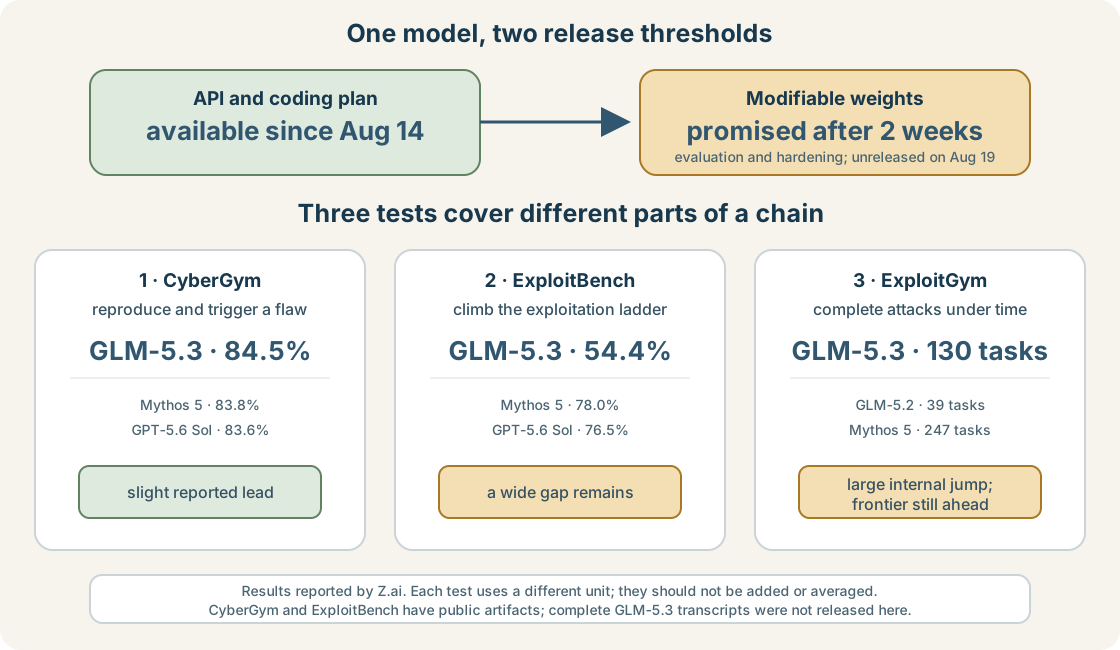
The scales cannot be averaged: one is a percentage of reproduced vulnerabilities, another scores progress through an exploitation chain, and the third counts tasks under normalized time. Nor are these independent results; Z.ai ran or collected the comparisons and did not release complete GLM-5.3 transcripts alongside the announcement. What does recur across tests is a direction: post-training produced an especially large gain in deeper exploitation, although a substantial gap remains there.
That pattern justifies evaluation before handing out a modifiable artifact. By itself, it does not justify any conclusion about real malicious use. A capability can find, reproduce, and fix flaws or exploit them; objectives, information, tools, permissions, and oversight make the difference. The current service preserves a point where Z.ai can observe abuse, restrict accounts, or withdraw a version. Weights will reduce that control while enabling independent evaluation, isolated execution, and defensive adaptation that an API may prevent.
A public ledger opens the door, but only slightly
Z.ai accompanies the release with a vulnerability disclosure ledger. It says its models, working with several security teams and followed by expert review and deduplication, found 2,436 flaws across 269 projects. On August 19, the ledger classified 107 as critical and 990 as high. That is more useful evidence than a number without objects: disclosed entries can link the project, age, severity, and CVE.
But the ledger’s own counter bounds the claim. Only 53 findings were listed as public, while 2,383 remained undisclosed. That reserve may be appropriate during coordinated disclosure; it also means the public cannot yet audit the vast majority, check how many maintainers accepted, distinguish new flaws from variants, or estimate false positives. For now, the total is an attributed result with a small verifiable sample, not 2,436 external confirmations.
My reading is that a staged launch is a reasonable response to a dual-use capability that advanced quickly. Temporarily retaining a control point is better than publishing by inertia because the previous generation had open weights. But “two weeks of safety” will be a policy rather than a promotional pause only if Z.ai explains which threats it is testing, who reviews them, what result permits release, which measures can survive weight modification, and what would trigger another delay.
The decision does not end when the files appear. A more demanding test begins then: whether the results reproduce with a public harness, whether the checkpoint substantively matches the service, and whether the ledger turns thousands of claims into disclosures acknowledged by affected projects. Until then, two ideas should be held together. GLM-5.3 appears to be a material advance in coding agents and cybersecurity. Its best result does not erase the gap in deeper exploitation, and promised weights are not yet an open release.
Sources
- Z.ai, GLM-5.3: Frontier Coding with Emergent Cyber Capabilities, August 14, 2026.
- Z.ai, GLM-5.3 documentation, migration guide, and API pricing, accessed August 19, 2026.
- Z.ai, Security Disclosure Ledger, accessed August 19, 2026.
- Wang et al., CyberGym: Evaluating AI Agents’ Cybersecurity Capabilities with Real-World Vulnerabilities at Scale, ICLR 2026.
- Lee and Brumley, ExploitBench: A Capability Ladder Benchmark for LLM Cybersecurity Agents, 2026 preprint and public artifacts.