JOURNAL / 2026.08.27
Qwen3.8-Flash-Next previews Qwen4 with three kinds of memory
Qwen has released the weights of a multimodal model intended to preserve capability with far less training compute; the architecture is inspectable, but its measurements remain internal and the new license restricts two important commercial uses.
Some releases matter because they raise a score. Others matter because they propose a different way to spend compute. Qwen3.8-Flash-Next, released on August 26, belongs mostly to the second group. It is an open-weight multimodal model and an experimental preview of the architecture on which Qwen says it is building Qwen4.
Its main network has 125 billion parameters but activates only 6 billion per token. It adds a 51-billion-parameter n-gram embedding table and a multi-token prediction module. The Hugging Face repository already contains 131 BF16 shards and occupies about 360 GB: this is not a promise of a later weight release. Native context is 262,144 tokens and can be extended to one million with YaRN.
The central claim is ambitious. In a 28-page technical report, the base model beats Qwen3.7-Plus-Base on eight of fourteen pretraining evaluations and trails by no more than 2.6 points on the other six. Qwen says it achieved this with one third as many activated parameters, one third as many training tokens, and roughly one ninth of the pretraining FLOPs. It is not nine times smaller, and this does not yet show that every task costs nine times less. The difference lies in how it combines several kinds of memory and where the system pays for them.
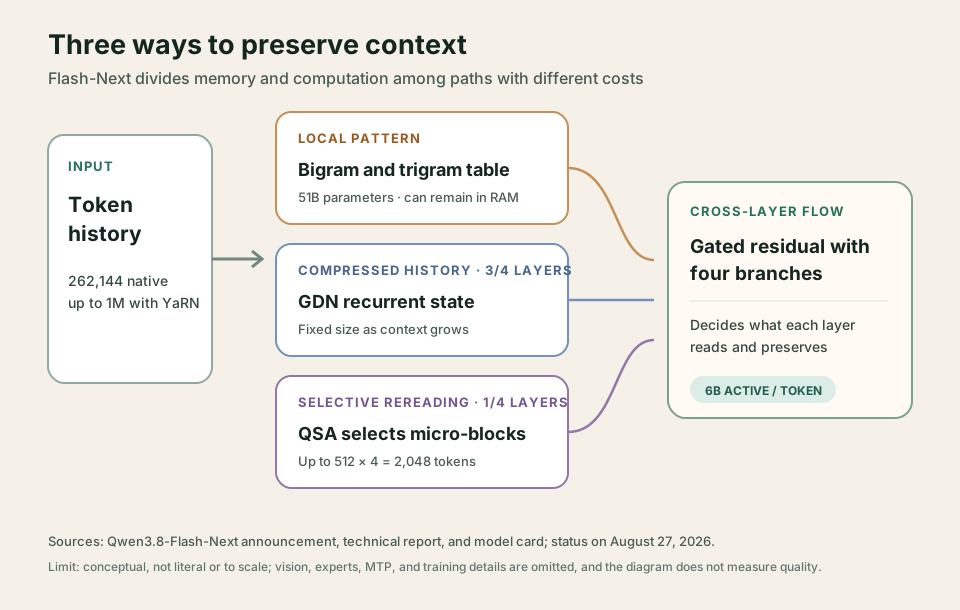
Remembering does not require looking at everything at once
One useful way to read the architecture is as three complementary paths. Three out of every four layers use Gated DeltaNet: they compress what came before into a fixed-size recurrent state. Its cost scales gently with longer context, but no finite memory retains every token for direct access.
The fourth layer compensates with Qwen Sparse Attention, or QSA. An indexer groups history into four-token blocks, scores those blocks, and selects up to 512 of them—2,048 tokens in total—for attention. The model can revisit particular passages without comparing every token with the entire past. Qwen first trained the indexer to imitate dense attention and then jointly adapted the network to the sparse pattern; applying the index without that second stage caused a clear quality drop.
The third path is local. A table indexed by bigrams and trigrams supplies 51 billion parameters of short-pattern associations. Because lookup addresses are known in advance, the table can remain in host RAM and be prefetched while the GPU computes. These are capacity parameters, not 51 billion new multiplications per token. That distinction is why counting every parameter in the checkpoint says little about its inference cost.
Around those paths, Gated Residual widens the residual stream into four branches and dynamically decides how much each layer reads and writes. In Qwen's ablations, the gate suppresses activation outliers and permits stable training with larger batches and learning rates. The team also applies Muon to suitable matrices and removes batch-size warmup, which took 18.8% more optimizer steps in its experiment without improving the result. This is not one spectacular invention. It is co-optimization across attention, memory, cross-layer flow, and training.
Where the measurement ends
The evidence is richer than a typical launch card. The report includes intermediate-scale ablations, training conditions, full-attention comparisons, stability stress tests, and base-model results. It also records choices that looked sound during pretraining and failed later, such as reading only the two highest-scoring residual branches.
It is still evidence produced by Qwen. The fourteen evaluations supporting the one-ninth-FLOPs claim compare base models under its own suite; they do not measure the cost of post-training, vision, tools, agent retries, or continuous serving. Evaluations of the finished model use several provider-selected harnesses, include internal tests, and in some cases use corrected data or another model as judge. They tell us what deserves reproduction, not who has won a neutral ranking.
The same boundary applies to speed. At one million tokens, Qwen reports that the QSA kernel is 7.6 times faster during prefill and 4.9 times faster during decoding than its dense-attention reference. These are attention-module measurements with 16,000-token chunked prefill and a particular batch and speculative-prediction setup; they are not complete application latency. The vLLM deployment recipe makes deployment concrete, but also shows the current floor: the BF16 checkpoint is about 335 GiB, the FP8 version about 173 GiB, and validated high-performance setups distribute it across several data-center accelerators. A lookup table that can live in RAM does not by itself make this a small model.
Open weights with a commercial gate
The release does enable what a closed API cannot: inspecting parameters and configuration, quantizing, fine-tuning, running independent evaluations, and checking whether QSA retains information outside Qwen's chosen tests. Initial vLLM and SGLang support exists, although some day-one paths still depend on dedicated images or unreleased branches. The production qwen3.8-flash, with built-in tools and one-million-token context by default, is also a different surface from the checkpoint, and its API was still marked as coming soon in the announcement.
“Open weights” does not mean Apache 2.0. Unlike Qwen3.8-27B, Flash-Next uses the Qwen Community License 1.0. It permits copying, modification, distribution, and fine-tuning, but requires a separate license to offer the model commercially as a service or as a standalone coding or office-work assistant. Very large products must also display the model name prominently. The architecture is open to examination; two of its most obvious markets are not open to commercial competition without additional permission.
Important pieces for a complete audit are also absent. The report does not describe the pretraining-data mixture, provide the complete training code, or include a safety evaluation of the post-trained model. Publishing weights enables much more study than an API, but it does not reproduce the process that created them.
My reading is that Flash-Next matters less as “another fast Qwen” than as a visible wager on the next bottleneck. If context and agents keep growing, applying dense attention everywhere and holding all memory on the accelerator is an expensive path. Qwen divides the problem: compress history, reread selected regions, store local patterns away from the GPU, and use gates to make training tolerate that heterogeneity.
The proposal can already be interrogated because the weights exist. It is not yet confirmed because the cost, quality, and safety evidence comes from the team that chose the architecture. The next valuable tests are clear: reproductions under equal budgets; end-to-end latency and cost on genuinely long contexts; information loss on tasks Qwen did not select; and, eventually, whether Qwen4 adopts these components without spending the saved compute elsewhere in the system. One ninth is a good reason to look. It is not yet a reason to multiply every conclusion by nine.
Sources
- Qwen Team, Qwen3.8-Flash-Next: A New Architecture, Towards Ultimate Cost-Efficiency, August 26, 2026.
- Qwen Team, On the Design of Qwen3.8-Next Architecture: Evaluation, Efficiency, and Training Stability, technical report, August 26, 2026.
- Qwen, Qwen3.8-Flash-Next weights, configuration, model card, and files, and Qwen Community License 1.0, accessed August 27, 2026.
- vLLM, Qwen3.8-Flash-Next deployment recipe, updated August 26, 2026.
- Qwen, Qwen3.8-27B model card, accessed August 27, 2026.