JOURNAL / 2026.09.03
Google launches Gemini 3.8 Flash: a more capable agent that also works more
The new model clearly improves long-horizon coding at the same per-token price as its predecessor; its own traces show why that does not mean the same cost per task.
Google has launched Gemini 3.8 Flash only three weeks after 3.7 and six after 3.6. This is not a preview: the stable model ID is already available through the API, AI Studio, Antigravity, Gemini Enterprise, the Gemini app, and AI Mode. The model keeps a one-million-token context window, 64,000-token output, and three reasoning levels, but is tuned for long-horizon coding and agents that use tools across many steps.
The rapid succession can look like one more update. It is not quite that. On long engineering tasks, 3.8 closes almost all the distance between the Flash family and far more expensive models. At the same time, Google's technical explanation contains the caveat that best defines the release: the model earns part of the improvement by doing more work. It takes more steps, calls tools more often, and consumes more tokens when effort is set to high.
Token price is not the price of finishing
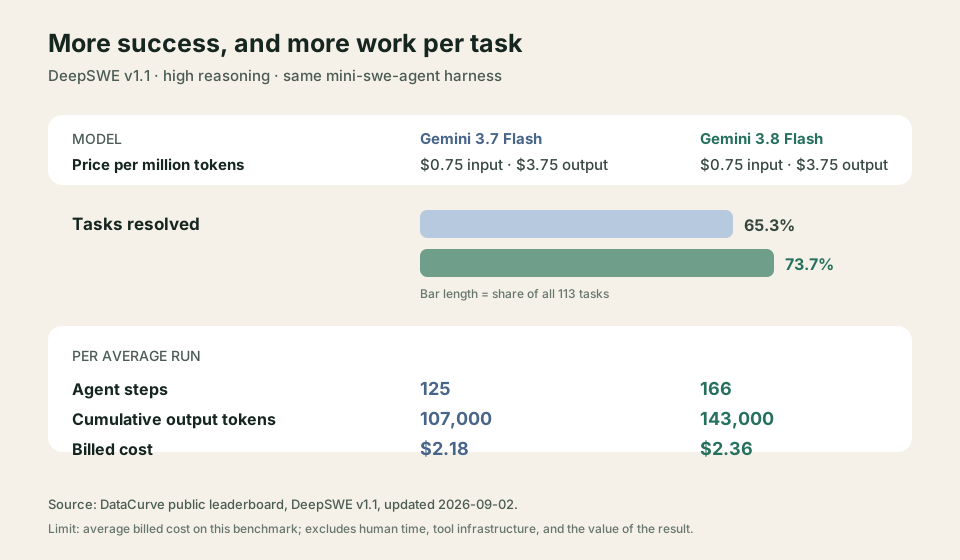
The cleanest comparison is on DeepSWE v1.1, a set of 113 original tasks across 91 repositories. The problems require long software changes, use hand-written verifiers, and run through the same mini-swe-agent harness. At high reasoning, Gemini 3.8 Flash resolves 73.7% of tasks, compared with 65.3% for 3.7. The published interval places 3.8 alongside Claude Opus 5 and GPT-5.6 Sol, not clearly above them.
The trace tells the other half. An average 3.8 run produces 143,000 output tokens across calls and takes 166 steps; 3.7 uses 107,000 and 125. Billed cost per task rises from $2.18 to $2.36. That is a modest increase for eight points of success, but it shows that “the same price” describes only the unit rate. It does not describe total latency, tool occupancy, or the cost of retries. Nor are those percentages a universal project-completion rate: the benchmark supplies an already-defined request, a prepared repository, and tests that know what success means.
Google's evaluation methodology helps keep a table from becoming an absolute ranking. Google computed the 3.8 DeepSWE result at high reasoning, although it matches the result displayed on the public leaderboard. On Terminal-Bench 4.0, a more general agent test, 3.8 rises from 11.2% to 19.1% over 3.7 but remains far behind Opus 5 at 51.8%. On HLE-Verified, for multidisciplinary expert reasoning, the difference is only 53.6% to 54.9%. The advance is large where training and harness fit well; it does not make Flash the best model for every job.
This changes how a migration should be evaluated. Google is holding the introductory rate at $0.75 per million input tokens and $3.75 per million output tokens through December 31; both figures double on January 1. The developer guide recommends lowering effort for ordinary tasks or keeping 3.7 when efficiency matters most. Choosing between them requires more than replaying a short prompt: measure the share of completed tasks, the cost of every call, time to a verifiable output, and the possible damage of a wrong action. An agent that costs 8% more and finishes much more often may be cheap; one that lengthens every run without improving the local test is not.
The Cyber variant opens another boundary
The release also includes Gemini 3.8 Flash Cyber, which shares the base intelligence but applies more permissive mitigations for defensive research. It is not in the general API. Google offers it, either alone or inside its CodeMender agent, to more than 650 organizations in the Fairwind program: public authorities, critical-infrastructure operators, software platforms, and approved security teams. Participants must restrict it to security personnel, use individual and phishing-resistant multi-factor authentication, log access, and not redistribute it.
Here too, the complete task matters. CWE-bench keeps 100 repository audits hidden and accepts a solution only if it blocks the exploit without breaking existing tests. Flash Cyber resolves 47.2% at $3.64 per attempt; Fable 5 reaches 47.8% for $10.27, while general Gemini 3.7 reaches 44.0% for $1.43. This is useful independent evidence of a new capability-cost combination. It also says that more than half of attempts fail. The most dramatic claims—more than 70% on an internal set spanning twenty languages, or one critical finding in under two hours—come from Google and do not include the artifacts needed to reproduce them.
The public documentation is uneven. The Gemini 3.8 Flash model card covers the general model and says it adds no material increase in Frontier Safety Framework domains over 3.7, whose evaluation did not reach its capability thresholds. It also records a 5.4 percentage-point regression on an automated multilingual-safety evaluation without publishing absolute rates; Google says manual review of the losses found mostly false positives or non-egregious cases. The Fairwind material describes Cyber access controls and results, but does not provide a separate card at the same level of detail. An admissions policy helps govern who uses the model; it does not replace evidence about what the model can do after access is granted.
My reading is that 3.8 makes it less useful to talk about “fast” and “expensive” models as fixed categories. The system can trade reasoning for time and money under the same model ID, and its actual cost emerges from the combination of model, effort level, harness, tools, and stopping rule. To build with it, the object that deserves versioning and evaluation is no longer just the prompt: it is the whole run.
Gemini 3.8 Flash does offer a material advance in coding agents at an accessible rate and with immediate availability. But its best lesson does not fit inside 73.7%. It lies in the 166 decisions that produce it. The more capable an agent becomes at continuing to work, the more important it is to decide in advance which test proves it is done.
Sources
- Google, Introducing Gemini 3.8 Flash and 3.8 Flash Cyber, September 2, 2026.
- Google DeepMind, Gemini 3.8 Flash model card, September 2, 2026.
- Google AI for Developers, Gemini 3.8 Flash guide and migration notes, updated September 2, 2026.
- DataCurve, DeepSWE v1.1, leaderboard updated September 2, 2026.
- Collinear, CWE-bench, version 0, September 1, 2026.
- Google DeepMind, Fairwind Program, accessed September 3, 2026.