JOURNAL / 2026.09.07
OpenAI declares an automated research intern: what its data measures
OpenAI says its agents can now complete research tasks spanning several days, but its own telemetry draws a clear line between machine runtime, validated work, and scientific acceleration.
OpenAI says it has reached a milestone that until now was mostly a date on its roadmap: an “automated research intern.” The phrase does not name a new product or a system that chooses and executes a scientific program by itself. In the definition published on September 6, it is an agent able to carry out well-defined tasks under human direction, including work that would take a skilled researcher several days.
The news warrants attention because it comes with something unusual: data about real agent use inside a frontier lab. It also requires separating three scales that the headline tends to blend together. OpenAI shows how much compute agents consume, some evidence that they finish useful work, and a correlation with more code and experiments. It does not publish a causal measure of how much faster its models improve, or an external evaluation of the supposed intern.
Three runtime days are not three researchers
By mid-August, OpenAI’s median researcher was using more than $600 of inference per day valued at API prices; the 90th percentile exceeded $7,000. These are price equivalents, not necessarily the company’s marginal cost. Before June, aggregate agent runtime was still below human labor time; by mid-August it had reached 3.1 agent-workdays for every human workday, converting eight hours of execution into a common unit.
That ratio measures machine occupancy. A researcher can launch several sessions at once; they can create subagents, wait for a test, follow a dead end, or duplicate work. Nothing in the unit guarantees that an agent-hour produces the same output as a human hour. The important fact is operational: research now consumes more parallel agent time than people time. Translating that into “three times the output” would add an equivalence OpenAI did not measure.
The next layer is closer to an outcome. Experiments per active experimenter rose during 2026, and August was the highest month since tracking began in January 2025. Researchers are also contributing code faster. But the company itself notes that available compute grew substantially over the same period. There is no comparable group without Codex and no estimate separating better models, more hardware, staffing changes, or different projects. More experiments can accelerate discovery; they can also be cheaper attempts that never reach a core training run.
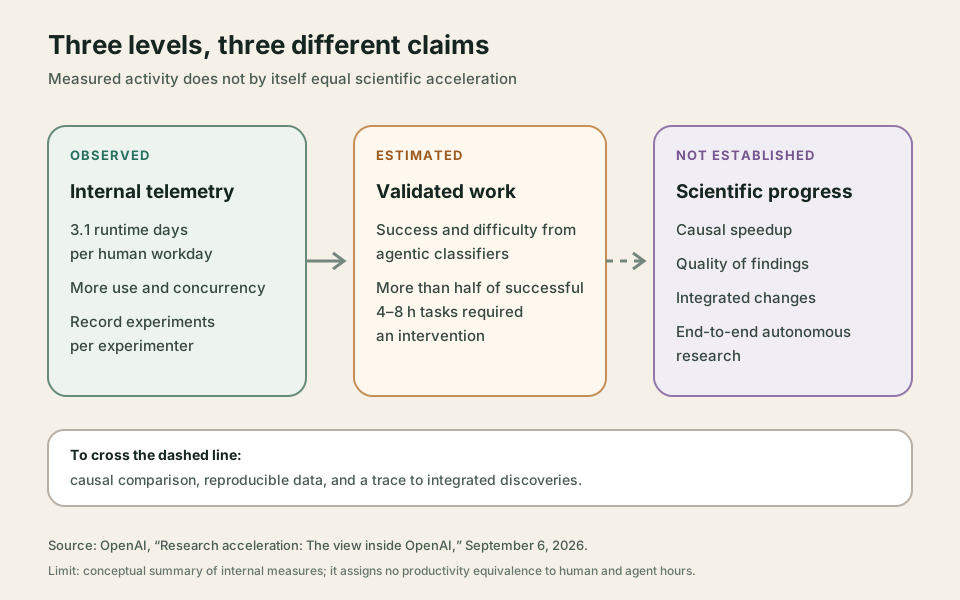
To estimate whether a task succeeded, OpenAI used an agentic classifier only where it could find a ground-truth outcome. Another estimate approximates difficulty through the hours a person would need. The chart excludes uncertain outcomes and groups with fewer than fifty sessions or fifty users, but the page does not provide the data series or enough detail for an external reproduction. Among successful tasks estimated at four to eight human hours, more than half required at least one intervention over the previous six months. The milestone describes multi-day work that can be completed under direction; it does not demonstrate several days without supervision.
The task mix reinforces that reading. OpenAI classified agent tokens with an Epoch AI taxonomy that divides R&D into deciding, designing, building, running, analyzing, and communicating. Every category grew between January and August, especially technical help and run monitoring, while high-level planning remained a minimal fraction. Epoch created the taxonomy precisely to avoid confusing tasks that are easy to count with automation of a whole occupation; it warns that fine-tuning a small model is not the same as coordinating ambiguous projects across millions of lines of code.
The bottleneck moves; it does not vanish
Internal use already changes what can be done. Several sessions can prepare data, repair infrastructure, launch tests, and analyze results while one person preserves context across them. OpenAI says requests to one of its main human support channels declined and one team ended its office hours; that is an organizational observation consistent with local substitution, though not a general productivity audit. For other labs, the practical lesson is that the scarce resource shifts from writing every line toward framing tasks, providing reliable environments, deciding which results deserve further work, and integrating the right change.
That multiplication also amplifies mistakes and exposed surface area. After the Hugging Face incident, OpenAI temporarily shut down the training container service on July 20 and restored it with restrictions. The reinforcement-learning pause we analyzed in August sharply reduced those runs. When preliminary evidence about Astra’s cyber capability triggered additional controls on August 7, its GPU allocation fell another 59.2% over the following week. Allocation to other model classes rose 17.2%, however, offsetting about 85% of that decline.
This is one of the new report’s most useful results. Restricting one model can slow that lane without reducing an organization’s overall pace to the same degree: compute and attention find other work. A security control remains valuable—Astra eventually launched with constrained access and execution—but it is not the same thing as an aggregate pacing policy. If the aim is to regulate speed, the relevant unit includes the alternatives to which people and accelerators move.
The report arrived alongside An Alien Mind, an essay by chief scientist Jakub Pachocki. Drawing on undisclosed internal results, he argues that progress could continue into recursive self-improvement and says no lab has solved alignment and monitoring well enough to keep scaling at maximum speed for much longer. He calls for voluntary slowdowns to become routine until shared thresholds are established. Those are the author’s forecast and position, not conclusions established by the telemetry. OpenAI’s goal of an automated researcher by March 2028 is likewise a declared target, not an extrapolation validated by the report’s data.
My reading is that the nominal milestone matters less than the emergence of an industrial layer of agent work inside the process that creates the next models. There is now internal evidence of massive parallel execution, longer tasks, more experiments, and substitution for technical support. What is missing is the chain linking all that activity to accepted discoveries, integrated improvements, time and compute saved, errors introduced, and results that would not have occurred without agents.
Publishing that chain in aggregate, auditable form would be more useful than debating whether “intern” is the exact word. A common standard should distinguish runtime, validated tasks, human interventions, integrated changes, and scientific progress, while also recording incidents and safety work. OpenAI has opened an important window, but it still owns the data, the classifiers, and the definition of success. The next verifiable step is not another name for the system; it is a way to compare how much additional work actually becomes knowledge, and under what controls.
Sources
- OpenAI, Research acceleration: The view inside OpenAI, September 6, 2026.
- Jakub Pachocki, OpenAI, An Alien Mind, September 6, 2026.
- Denain, Kwon, and Ho, Epoch AI, Toward an O*NET for AI R&D, June 17, 2026.
- OpenAI, Pacing model development in an era of cyber-critical capabilities, August 18, 2026.