JOURNAL / 2026.09.08
The complete male fruit fly connectome is an experimental map, not a simulation
AI made it feasible to reconstruct 166,691 neurons from microscopy, but the result published in Cell also required 44 person-years of proofreading and still cannot explain behavior by itself.
The Cell publication of the complete connectome of a male fruit fly's central nervous system places an awkward and useful number beside the promise of automating science: 44 person-years. That is the team's estimate for proofreading machine-generated segmentation before microscope images became a usable neuronal map.
It would be wrong to describe September 3 as the day the whole map suddenly appeared. The preprint was published in 2025, and version 1.0 of the dataset had been available since June 2026. This week's event is its formal publication, accompanied by studies already using the resource to trace visual and gustatory circuits. It is a good moment to examine the complete result because it shows a less conspicuous and probably more durable kind of AI progress than a generative-model launch: expanding the scientific instruments that can be built.
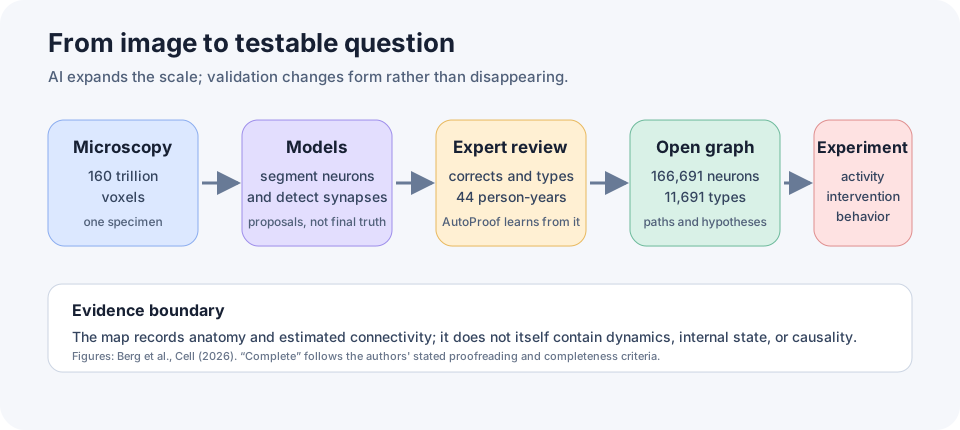
The starting point was 160 trillion voxels captured at eight-nanometer isotropic resolution. Seven enhanced focused ion beam scanning electron microscopes worked for thirteen months on one nervous system, from the brain and optic lobes through the ventral nerve cord, a rough functional analogue of the spinal cord. Flood-filling neural networks turned that volume of flat images into three-dimensional neuron fragments, while other models located synapses and predicted neurotransmitters.
The automated output was not yet a finished connectome. In the team's evaluation, synapse detection reached average precision of 0.82 and recall of 0.81: enough to accelerate the work, not enough to accept every link without examination. Specialists searched for false merges, assembled separated fragments, compared homologous neurons, and assigned types. The authors estimate 44 person-years of manual proofreading, performed in parallel by a team trained for the task.
A second machine-learning layer, AutoProof, learned from those human decisions and automatically accepted about 200,000 highly conservative merge proposals. Its threshold targeted an estimated error rate of roughly 3%; it added 1.3 percentage points to connection completeness and saved the estimated equivalent of another four person-years. It did not replace proofreading: it reused its trace to handle a band of small fragments.
What “complete” contains
The final resource identifies and annotates 166,691 neurons, including sensory projections, and organizes them into 11,691 types. For the first time in a male, it joins the brain, optic lobes, and nerve cord without breaking the neck connective. Researchers can query it in neuPrint, explore it in Neuroglancer, or download images, segmentation, connectivity tables, and annotations under a CC BY license. That availability turns a publication into infrastructure: someone can start with a sensory neuron and search for paths to a motor output instead of reconstructing every segment from scratch.
But “complete” is a technical term, not an absence of gaps. The team proofread every automatic fragment with more than one hundred synaptic connections and attached 94% of presynaptic and 42% of postsynaptic sites in neuropil regions to proofread neurons. When both ends of a connection must belong to traced neurons, overall completeness is 40.1%. Millions of orphan fragments remain, overwhelmingly tiny, and some profiles could not be reconstructed because of sample artifacts. A map can be finished under a declared criterion while retaining local uncertainty.
That precision matters when interpreting the comparison between sexes. Matching the male brain against earlier female connectomes, the authors found 7,205 isomorphic types, 114 dimorphic types, 262 male-specific types, and 69 female-specific types. The differences concentrate in higher brain centers, while the sensory and motor periphery is mostly similar. They also propagate: a small share of distinct types can alter connectivity across a much larger part of the network.
This is a powerful anatomical finding, not a population estimate. The male specimen is one individual, and the comparisons use other individuals and datasets. The analysis tries to separate technical variation, individual differences, and dimorphism through matching, statistics, and expert review, but those samples cannot become a distribution for the whole species. The suggested pathways must be tested in animals.
The companion papers show what this transition is already good for. One traces information from photoreceptors and concludes that more than half of central-brain neuron types receive propagated visual signals; its predictions agree with available physiological data and offer targets for measuring thousands of uncharacterized types. Another reconstructs taste circuits through outputs for feeding, foraging, endocrine regulation, and social behavior. The connectome changes the experimental question from “where do I start?” to “which of these paths should I perturb?”
That is also its boundary. A wiring diagram does not by itself contain the dynamic strength of every synapse, the animal's internal state, chemical modulation, learning, or the activity accompanying a decision. Nor is it an executable digital brain. It can generate structural hypotheses with previously impossible coverage; causality still requires recording, intervention, and behavior.
My reading is that this project describes the immediate future of scientific AI better than the idea of a solitary agent “making discoveries.” The new capability emerges from a chain: specialized instrumentation, models that reduce an immense search space, experts who correct and classify, a queryable archive, and laboratories that test the resulting paths. The most valuable automation does not remove every bottleneck; it converts an impossible one—manually following every pixel—into a tractable one—deciding which errors and circuits deserve human attention.
The 44 person-year figure does not refute AI's role. It explains why AI was necessary and, at the same time, why “automated” would be an incomplete description. The important measure for the next connectome will not be only how many neurons a model segments, but what completeness it achieves, how much expert work moves from routine correction to interpretation, and how many predictions survive experiment. This map already makes it possible to ask questions at the scale of an entire nervous system. It does not yet answer them for us.
Sources
- Berg et al., Sexual dimorphism in the complete connectome of the Drosophila male central nervous system, Cell, September 3, 2026.
- HHMI Janelia, Male CNS Connectome data, tools, and documentation, accessed September 8, 2026.
- Google Research, A connectomics milestone: Mapping the complete male fruit fly brain, September 3, 2026.
- Nern et al., The organization of visual pathways in the Drosophila brain, Cell, September 3, 2026.