JOURNAL / 2026.09.09
AlphaGenome Atlas maps predictions for 9 billion variants—not diagnoses
Google DeepMind has precomputed molecular effects for every possible single-letter change in the human genome; the new scale accelerates search, but it does not turn an AI score into clinical causality.
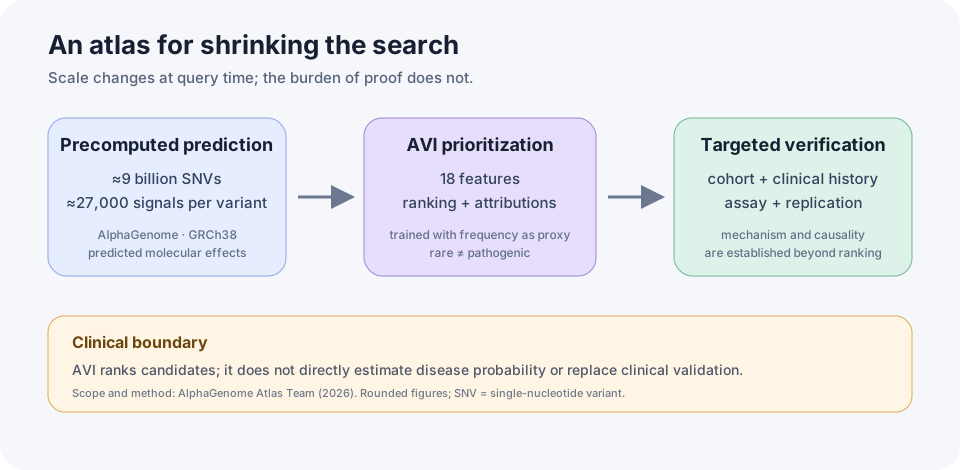
A person with a rare disease may have four to five million variants in their genome. The problem is not only finding them, but deciding which ones deserve months of experimental work. Since September 8, part of that search can begin with a query: Google DeepMind has released AlphaGenome Atlas, a one-petabyte resource with predictions for roughly 9 billion possible single-letter substitutions in the human reference genome.
That scale needs precision. These are not 9 billion mutations observed or verified in people. At each of roughly 3 billion positions, the system substitutes the reference letter with each of the other three and estimates what would change in molecular processes. Atlas adds more than 100 million insertions and deletions observed in large biobanks, but not every possible structural variant. It is exhaustive in silico mutagenesis for one class of change, not a catalogue of every human biological effect.
From running a model to querying a scientific layer
AlphaGenome, published in Nature in January, could already read up to one million bases of context and predict thousands of signals: gene expression, chromatin accessibility, transcription-factor binding, histone modifications, RNA splicing, and three-dimensional contacts, among others. The model matched or exceeded the selected best external system in 25 of 26 variant-effect evaluations. Its weights, research code, and API were already available for academic use.
The new part is removing inference from the ordinary path. The Atlas technical manuscript describes how the team traversed the GRCh38 reference genome in windows, reused each reference calculation, and precomputed an average of about 27,000 scalar predictions per variant. A query can return both a high-level score and the tissue, assay, or molecular signal driving it. For laboratories without the capacity to run millions of inferences, the change looks less like a better model and more like the arrival of a new layer of scientific infrastructure.
The resource also introduces the AlphaGenome Variant Impact (AVI) score. A small model combines eighteen features: ten AlphaGenome summaries, the AlphaMissense protein prediction, three protein consequences, two measures of evolutionary conservation, and two indicators for insertions or deletions. Its result is transformed onto a PHRED scale: 20, for example, means a variant is in the top 1% of predictions, not that it has a 99% probability of causing disease.
That compression is both useful and dangerous. For each modality, AVI takes the largest predicted effect across tissues, making it easier to rank millions of candidates while flattening cellular context. Atlas preserves the details and provides SHAP contributions that decompose the score, along with 2,601 inferred sequence motifs; even so, an attribution explains which inputs raised the model's output, not that the mechanism has been demonstrated in a cell.
Rarity taught the ranking; it does not prove disease
The most important methodological decision lies in the training labels. AVI learned to distinguish human variants with frequencies above or below 0.1%: frequent variants acted as a proxy for “neutral,” and rare ones as a proxy for “impactful.” Natural selection makes that a reasonable population-scale signal, but a rare variant can be harmless and a frequent variant can matter. The authors therefore recommend application- and region-aware rankings and thresholds, not one universal cutoff.
On separate test sets, the score was especially strong where tools are currently weakest. When distinguishing pathogenic and benign intronic ClinVar variants, it reached 0.76 area under the precision–recall curve versus 0.44 for the next compared system. This metric asks whether relevant cases appear early without flooding the list with false positives; it does not measure the percentage of patients diagnosed. ClinVar sets also do not represent every ancestry, tissue, or as-yet unknown variant equally, and the team that built AVI performed the comparison.
The most persuasive case is not a benchmark bar. Among 814 unsolved family trios from the GREGoR consortium, AVI ranked first a deep intronic DNM1 variant in a patient with epileptic encephalopathy. AlphaGenome predicted that it created an incorrect splice site in a brain isoform while the signal in blood was minimal, explaining why an earlier blood RNA analysis had not resolved the case. Literature on nearby variants supported the mechanism, and an experiment mutating 265 nucleotides across five cell lines reproduced both the disruption and its length. The combined evidence supported recommending reclassification as “likely pathogenic.” The prediction narrowed the search; clinical history, prior evidence, and experiment supported the conclusion.
Another analysis, involving 54,189 UK Biobank participants and blood levels of 2,028 proteins, found 22% more independent rare non-coding variant associations when filtering with Atlas features. That is evidence of discovery utility, not general clinical validation: the authors note that they used a slightly earlier version of the resource, covered a limited set of traits, and that ultra-rare variants are intrinsically difficult to replicate.
My reading is that AlphaGenome Atlas materially changes the economics of the first screen. Precomputation does not make a prediction truer, but it lets more groups explore genome-scale hypotheses, compare mechanisms, and design the next experiment without first reserving a GPU or waiting for millions of queries. It also concentrates epistemic power: a convenient single score can become a default filter well before we know where it fails in underrepresented populations and cells.
Access reflects that tension. The portal and API are free for non-commercial research; the terms prohibit using most outputs to train other models and rule out clinical decision-making. Google Cloud's commercial service requires a subscription and paid infrastructure. “Available to researchers worldwide” therefore does not mean a one-petabyte dataset freely available for any use.
The test that matters now will be external and cumulative: how many prioritized variants yield reproducible mechanisms, how many cases are solved relative to existing processes, how AVI calibrates across ancestries, and how much experimental work it saves without filtering out true signals. Atlas turns a space impossible to traverse by hand into a navigable list. It does not turn that list into a diagnosis—which is precisely why its best use begins where the ranking ends: at the experiment.
Sources
- Google DeepMind, AlphaGenome Atlas: A predictive map of every possible DNA letter change in the human genome, September 8, 2026.
- AlphaGenome Atlas Team, AlphaGenome Atlas: in silico mutagenesis of the entire human genome improves prioritization and interpretation of non-coding variants, technical manuscript, September 2026.
- Avsec et al., Advancing regulatory variant effect prediction with AlphaGenome, Nature, January 28, 2026.
- Google DeepMind, AlphaGenome repository, API, and terms, accessed September 9, 2026.
- Google Cloud, AlphaGenome documentation for Gemini Enterprise Agent Platform, accessed September 9, 2026.