JOURNAL / 2026.09.15
Épi publishes 120 record results: what they actually verify
Bake AI's research system delivers constructions, bounds, and a proof with public certificates; the evidence supports checkable advances, but not yet a complete measure of scientific autonomy.
An agent can propose a thousand solutions and get one right. A research system faces a harder requirement: preserve what it learns, distinguish a real improvement from a numerical mirage, and leave evidence that someone else can check. Épi, introduced by Bake AI on September 12, tries to turn that distinction into an architecture.
The company attributes to its agents 120 results that improve previous records in a few days: 20 numerical bounds across twelve problem families and 100 constructions across another eight. It separately counts a computer-assisted extension of a case of Tuza's conjecture. Most of the results, Bake says, were obtained with GPT‑5.6 Sol and GPT‑6 Astra. The announcement describes memory across sessions, strategies that change with the evidence, parallel experiments in persistent sandboxes, and a verifier that remains fixed within each investigation.
What is new is not merely that a model found a better number. It is the attempt to sustain many searches across different domains without losing earlier attempts, and to publish the outcome in a form that does not depend on believing the model's answer. The Épi Results repository contains indexes, construction coordinates, witnesses, certificates, comparison sources, and checksums. That puts Épi above a collection of videos or screenshots. It does not yet make it a demonstrated autonomous laboratory.
One hundred and twenty does not mean 120 theorems
The total combines objects with different scientific weight. Eighty-two of the 100 constructions are instances from just two families: packing circles in a quadrant and balls in four dimensions. Each value for the number of objects counts as a separate record. Other entries are vehicle routes, pentagon packings, or optimized inequalities. They are concrete improvements and potentially useful starting points, but the count is not equivalent to 120 independent ideas or 120 questions selected by the system.
The 20 bounds include results closer to a traditional mathematical contribution. Épi lowers an upper bound for the polyomino growth constant from 4.5238 to 4.29569 using an exact certificate with 1,186 neighborhood types. It narrows the published rigorous interval for the n-queens constant by about 84 times. In dimensions 10 and 11, it obtains certified bounds which, if the comparison is correct, prove that the well-known Cohn–Elkies linear program cannot reach the exact sphere-packing density. These are different kinds of advance: a better construction, a narrower interval, and a limit on a method do not say the same thing, even if all fit under the word “record.”
The most revealing example about the process may be more modest. In a 56-minute session, Épi improved a published arrangement of 34 pentagons inside a triangle 17 times. The first two proposals contributed most of the gain; another fifteen extracted the rest. Here the value of continuity is visible: the agent does not merely generate one answer, but preserves a best result and keeps exploring against the same acceptance rule. The limit is visible too: a persistent optimizer inside a clear metric is not the same as formulating the question worth investigating.
The checker ends where mathematical judgment begins
The Tuza extension offers a closer view of that boundary. The conjecture relates the smallest set of edges that meets every triangle in a graph to the largest set of triangles that share no edges. Épi's work extends an earlier case for split graphs whose complete core has eight vertices: among outside vertices that participate in triangles, it now allows as many as three distinct neighborhood types rather than two, with arbitrary multiplicity.
The published proof reduces the problem to 872 classes. General arguments cover 312, and a certificate enumerates the remaining 560 through 18,444 multiplicity boxes. In our review, we ran the included independent checker: it regenerated the classification, traversed the certificate, and completed without errors with those same figures.
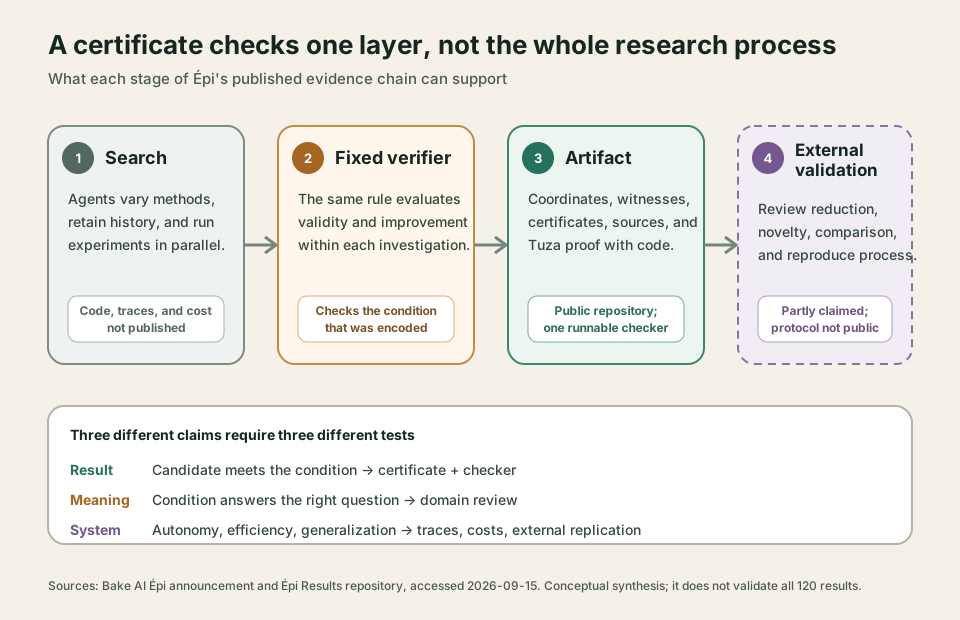
That is substantive evidence, but it is important to name exactly what it proves. The program checks that the encoded covers and packings satisfy the inequality over the declared finite region. By itself, it does not certify the written arguments that justify the reduction, the lemma extending multiplicities to infinity, bibliographic novelty, or that an outside run reproduced the result from scratch. Bake says the work received independent verification, but the public page neither names the reviewer nor describes the protocol. Moreover, this is the only result in the repository with an executable checker; other certificates are released as artifacts whose separate validation is reported, without the corresponding code in the same release.
There is another important absence. Bake does not publish Épi's code, complete traces, initial problem set, selection criteria, total attempt count, compute or tokens per result, or an accounting of human work. Without those denominators, it is impossible to measure the hit rate, compare efficiency with specialized search, or know how much editorial filtering took place between exploration and the final 120 records. The failure case it does show—seven hours and 31 approaches without improving a flat polynomial—is valuable precisely because it reminds us that a record list displays only the selected successes.
This distinction fits seemingly contrary evidence. A study of two shadow evaluations gave frontier agents six days to reconstruct the central questions of still-unpublished NeurIPS papers. The agents completed the engineering, but the original authors rejected both projects for failing to make substantial research progress. Épi does not overturn that result. It operates on problems where an objective function, exhaustive test, or interval arithmetic can provide a much cleaner signal. Choosing which question matters, repairing a flawed methodology, and recognizing a deep explanation remain a different class of work.
My reading is that the real advance lies between two extreme stories. Épi does not demonstrate a general autonomous scientist; it does show a candidate factory able to retain context, vary methods, and accumulate improvements in verifiable environments, with some outputs accompanied by objects that withstand mechanical checking. That combination can change practice in computational mathematics, algorithm design, and optimization—not because it removes the specialist, but because it gives one a wider frontier of concrete candidates to audit.
The next version of the evidence should make the system that produced the certificates auditable too. Publishing the protocol, a complete ledger of attempts and costs, human intervention, and reproducible checkers for every family would allow Épi to be compared with other agents and specialized methods. Identified mathematical review and external reproduction must follow, along with experimental confirmation when the work leaves formal domains. A certificate can close an inequality. On its own, it cannot close the question of who did the research or how much of it generalizes.
Sources
- Bake AI, Épi: Turning compute into verifiable improvement, September 12, 2026.
- BakeLab, Épi Results repository, artifacts and comparisons accessed September 15, 2026.
- BakeLab, proof and certificate for the Tuza conjecture case, accessed September 15, 2026.
- Zijian Zeng, Tuza’s Conjecture for Split Graphs with an Eight-Vertex Clique Part and Two Neighborhood Types, August 2026.
- Peter Kirgis et al., Can AI agents conduct open-ended AI research? Early evidence from two case studies, July 29, 2026.