JOURNAL / 2026.09.21
Huawei Atlas 960E brings optics closer to 4,096 AI accelerators
Huawei redesigns its next AI supercomputer interconnect around near-package optics; the architecture addresses a real bottleneck, but its accelerators arrive in 2027 and its figures remain vendor promises.
On September 17, Huawei unveiled the Atlas 960E SuperPoD, a system that will connect up to 4,096 Ascend 960 accelerators through UnifiedBus and Hi-ONE optical engines. The company assigns it one petabyte of HBM and peaks of 8 exaflops at FP8 or 16 at FP4. That is enough scale for cabling, the energy used to move data, and failures across thousands of links to become part of the computer rather than accessories around its chips.
That is the material novelty: Atlas 960E uses near-packaged optics (NPO), placing optics beside the silicon that originates the traffic. Huawei has not published a training result or a model produced with the machine. It cannot be installed today, either: Ascend 960DT will become available in the first quarter of 2027 and 960PR in the third, while the company gives no delivery date for the complete system. The unveiling warrants attention as an architecture and an industrial timetable, not as production performance already demonstrated.
Shortening the electrical part of the journey
A SuperPoD attempts to make many physical nodes behave as one logical machine, with unified memory addressing and a high-speed interconnect. As it grows, the problem is no longer only how many operations each accelerator performs. Distributed training stops to exchange gradients, activations, and state; if the network loses time, energy, or availability, adding chips increases the catalog figure faster than useful work.
The Optical Internetworking Forum's technical definition places an NPO engine on the host board, adjacent to the processor, to minimize electrical trace length. The signal is converted to light sooner and travels over fiber across the distance that copper handles less well at high data rates. This is not the same as integrating optics and processor in a single package; it preserves two nearby components and, with them, a physical boundary that may ease manufacturing or replacement.
Huawei says each Hi-ONE carries 7.2 terabits per second and includes its light source. In the complete design, 5,500 Hi-ONE engines would remove the need for 48,000 pluggable 800G optical modules. The company calculates that the substitution saves more than 550 kilowatts, doubles fault-free operating time, and enables 99.8% system availability. The quantities make the argument tangible: at this scale, changing where electro-optical conversion happens can remove tens of thousands of active parts and an industrial infrastructure load of its own.
They also mark the evidence boundary. Huawei does not publish the reference configuration consuming those extra 550 kilowatts, the period used to estimate availability, a failure distribution, or measurements performed by a third party. The 8 and 16 exaflops are peaks in low-precision numeric formats, not sustained speed while training an identified model. FP4 is arithmetically twice FP8 on the specification sheet, but that relation says neither what accuracy a training run retains nor how long chips sit idle waiting for data.
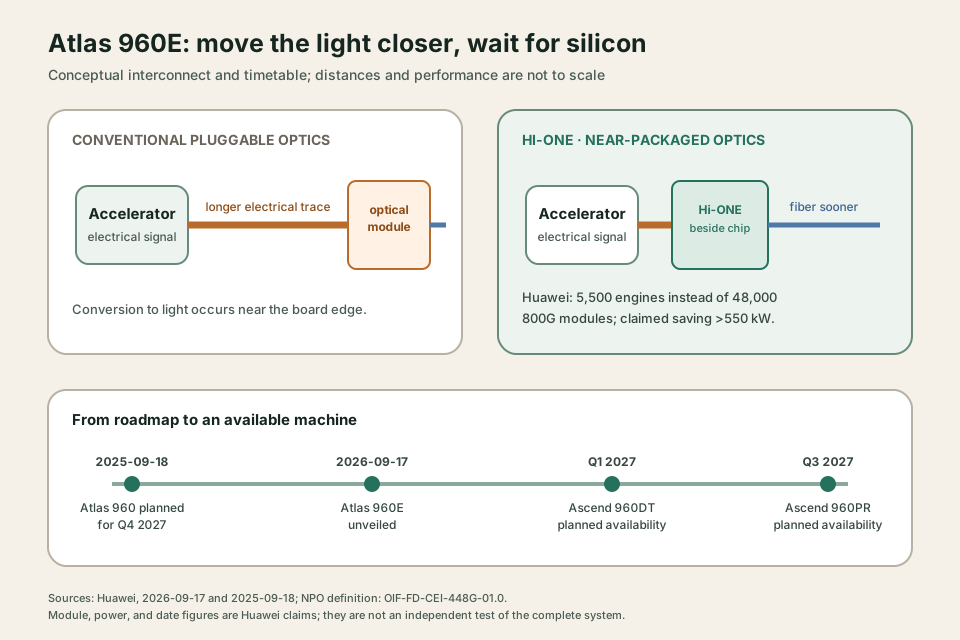
A new 960E is not yet the promised 960
Comparison with the roadmap Huawei published in September 2025 prevents another confusion. It then announced an Atlas 960 with 15,488 accelerators, 30 FP8 exaflops, and delivery in the fourth quarter of 2027. The 2026 unveiling describes a 960E with 4,096 accelerators and 8 FP8 exaflops. Huawei does not say the latter cancels or replaces the former, nor whether it will be its modular building block. These are not figures that should be framed as a silent downgrade.
What explicitly changed is the chip family. The generic Ascend 960 planned for late 2027 is now split into a 960DT for training and decode in the first quarter and a 960PR for inference in the third. Pulling the first component forward by three quarters is material, although “available” still needs a volume, price, compatible servers, and software capable of keeping it busy.
Huawei supplies some industrial continuity: it says it has deployed more than one thousand Atlas 900 A3 systems and that Atlas 950 has entered large-scale commercial use. A year earlier, it reported more than 300 A3 systems across twenty customers. That progression makes it more credible that 960E belongs to a product line rather than being only a mockup. It remains a manufacturer count without a list of installations, sustained workload, total consumption, or published utilization rate.
The announcement also extends the diagram to 512,000 accelerators connected through a Clos network and one million after adding multiple rails. That figure describes the maximum capacity of a future topology, not one coherent memory or a built machine. Every tier adds switches, failure domains, and scheduling software. Installing one million devices would be a physical milestone; making them an efficient resource is a different claim, requiring utilization, interruption intervals, and progress per unit of energy.
Optics matters more than the exaflops record
My reading is that Atlas 960E signals a serious answer to a constraint that cannot be solved by simply manufacturing a larger chip. Huawei explained in 2025 that, given limited access to advanced process nodes, its strategy is to combine more resources through its own system architecture. Moving optics closer to the processor turns that strategy into a concrete component: it attempts to pay less energy and fewer failures for every additional accelerator.
It also concentrates risk. UnifiedBus, Ascend chips, memory, Hi-ONE, liquid cooling, and CANN must mature together. Huawei says it has submitted an NPO implementation-agreement proposal to the OIF, but a proposal is not yet an adopted specification and does not guarantee interoperable components from other vendors. CANN has moved to continuous open development, according to the company; that makes more software inspectable without opening the silicon, reliability measurements, or the complete system.
The useful test in 2027 will not compare its NPU count with another vendor's GPU count. It will run an identified workload for weeks and publish how much peak capacity becomes useful training or inference, including wall power, failures, repairs, and system cost. It will also need to distinguish whether the 550-kilowatt saving belongs to a configured system, a simulation, or a design extrapolation.
If those measurements sustain the promises, the practical change would be significant: training and serving large models with manufacturable chips and a tightly integrated optical network would provide another route to frontier infrastructure. If they do not appear, Atlas 960E will remain a good illustration of where the bottleneck is moving. Either way, the announcement leaves a lesson less flashy than a record: when four thousand accelerators must act as one, system capability depends as much on where fiber begins as on how quickly each chip multiplies.
Sources
- Huawei, Huawei Launches the World's First NPO-based SuperPoD – the Atlas 960E SuperPoD, September 17, 2026.
- Huawei, Advancing the Agentic World, Building a Solid Silicon Foundation, keynote and technical Q&A, September 17, 2026.
- Huawei, Groundbreaking SuperPoD Interconnect: Leading a New Paradigm for AI Infrastructure, roadmap published September 18, 2025.
- Optical Internetworking Forum, Next Generation CEI-448G Framework, OIF-FD-CEI-448G-01.0, November 4, 2025.