JOURNAL / 2026.09.22
Grok 4.7 improves long tasks, but per-token pricing hides the real cost
SpaceXAI has introduced a larger base model with clear gains in coding agents and professional work; external tests confirm the improvement, but also show that maximum effort can use more than twice as many tokens.
SpaceXAI released Grok 4.7 on September 21, making the proprietary model available on day one through its API, Grok Build, Cursor, and several gateways. This is not just another post-training stage applied to Grok 4.6: the company says it starts from a new, larger base model, although it does not disclose the parameter count, and received a longer supplemental-training and reinforcement-learning run weighted toward tasks that can last for hours.
The result does appear material. Grok 4.7 improves on programming, terminal, engineering, and document work that requires many steps, and an evaluation outside the provider reproduces an important part of the gain. But it also exposes a distinction that API pricing tends to hide: keeping the same rate per token does not keep the same cost per task. At its maximum-effort setting, the model thinks much more than its predecessor to obtain an aggregate gain that is considerably smaller than the increase in compute.
That is the useful reading of this release. Grok 4.7 expands the set of jobs worth attempting with an inexpensive agent; it does not turn two dollars per million input tokens into the price of a finished result.
A larger model trained to stay with the task
The model card describes a recipe built from model-generated data, technical corpora, trajectories produced by Grok 4.6, and reinforcement learning across coding, knowledge work, kernel optimization, web development, and computer-aided design. Like 4.6, it also received supplemental training on anonymized Cursor workflow data. The pretraining cutoff reaches June 2026, and material generated for supplemental training reaches August.
The operational envelope changed less than the model. It retains a 500,000-token window, text and image input, text output, function calling, search, and code execution. The API exposes four reasoning levels and defaults to high. The documentation preserves Grok 4.6's base rates: $2 per million input tokens, $0.50 for cached input, and $6 for output. Requests above 200,000 input tokens, however, double all three rates. The Fast version doubles both speed and price and is not on the public API.
The cleanest capability signal appears where the test and effort setting stay fixed. On CursorBench 4.0, which collects ambiguous, multi-file tasks from real Cursor sessions, Grok 4.7 at high resolves 43.9%, compared with 40.4% for 4.6. The average cost of that run falls from $5.20 to $4.69 per task even as average token use rises. At xhigh, the score moves from 41.4% to 46.3% while cost is almost unchanged: $6.10 versus $6.01. On this workload, the new version gets more accepted work for similar spending.
Other tests point in the same direction. On DeepSWE v1.1—113 new issues with handwritten verifiers and the same mini-swe-agent harness—it rises from 65.2% to 71.0% at high effort. On SWE-Marathon, twenty engineering jobs run eight times in each provider's native harness, it rises from 31.9% to 46.0%. The latter difference is large, but the task sample is small and measures the complete Grok Build system, not the model in isolation.
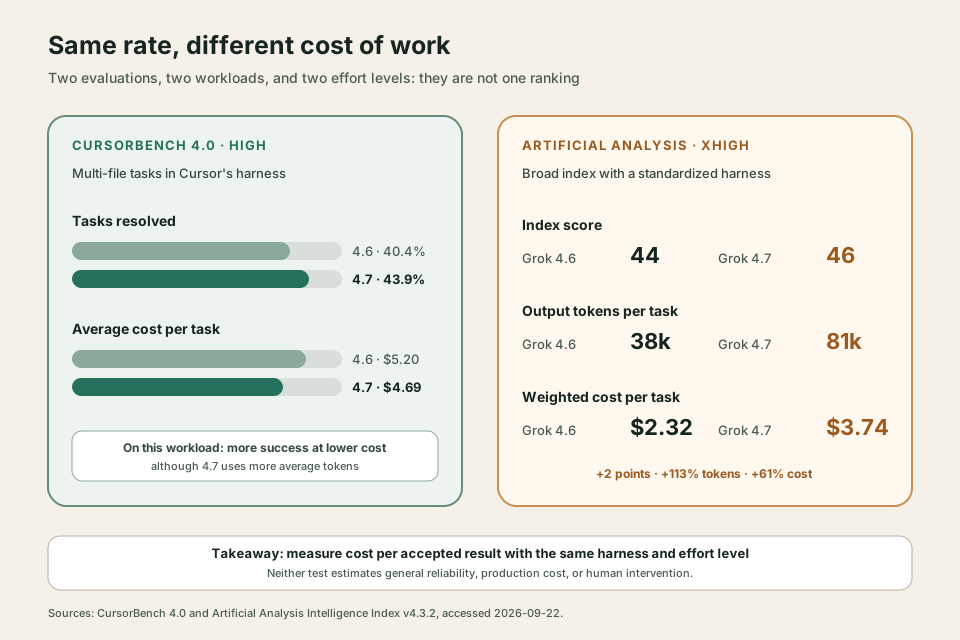
The external check from Artificial Analysis preserves the advance while shrinking the headline. On its broad index, Grok 4.7 xhigh scores 46 versus 44 for Grok 4.6 xhigh. Its improvements are concentrated in agentic knowledge work and coding; outside those areas it broadly matches 4.6, gaining on some tests and regressing on others. With Grok Build, its Coding Agent Index rises from 47 to 56, placing it fourth behind Claude Fable 5.1, GPT-6 Astra, and Claude Opus 5.
The compute price matters. Artificial Analysis records about 81,000 output tokens per index task for 4.7 xhigh, compared with 38,000 for 4.6 at the same level. Its weighted average cost rises from $2.32 to $3.74 per task: 61% more for two additional index points. This is not a universal bill—it depends on that evaluation mix, cache behavior, and harness—but it contradicts any reading in which “same price” automatically means “same work cost.”
The two observations do not cancel each other out. CursorBench shows a real efficiency improvement on one workload; the broad index shows that requesting maximum effort across varied work can multiply reasoning. The practical decision is not to pick a single winner but to route: measure medium, high, and xhigh on your own tasks, and reserve the larger budget for cases where it changes the verifiable result.
Safeguards also depend on the setting
SpaceXAI says it rebuilt the safeguard stack from scratch. The model card provides more detail than the announcement and does not support a uniformly positive story. On standard jailbreaks, the compliance rate for requests that should be refused falls from 0.04% with Grok 4.6 to 0.01% with 4.7; on StrongREJECT, it falls from 3.9% to 2.0%. On MASK-Rectified, a limited proxy for dishonesty under pressure, it falls from 1.9% to 0%.
Other indicators move the opposite way. On the internal general harmful-request suite, failure rises from 0.93% to 1.10%, and in self-harm conversations it moves from 0.84% to 1.05%. These are small rates evaluated on internal sets with automated judges, without published sample sizes or intervals; they cannot estimate production incidents. They do prevent the new stack from being summarized with one word such as “better.”
Cybersecurity shows another asymmetry. Without production safeguards, 4.7 improves only from 79.7% to 80.3% on CyberGym and regresses from 39.8% to 37.7% on CVE-Bench at high effort. On CathedralBench, an external evaluation of difficult exploit chains, it rises from 25% to 29%. There is no general offensive-capability leap comparable to the progress on long software tasks.
With safeguards enabled, the internal HackerBench reports that Grok 4.7 high complies with 3.31% of harmful or dual-use cyber requests that it should refuse, compared with 5.93% for 4.6. But xhigh worsens to 4.02%. More reasoning raises capability and, on this test, gives back some of the safety advantage. The effort level therefore belongs in a deployment evaluation rather than being treated as a neutral quality control.
In biology, the card says the model remains below the frontier framework's thresholds and does not increase dangerous capability over 4.6. The LatchBio evaluation does improve the balance between refusing covertly harmful tasks and answering routine research, from 45.6% to 62.4%, while surveillance and biological-function tests improve little or not at all. That is evidence of calibration on these sets, not a general guarantee against abuse.
My reading is that Grok 4.7 represents a serious but bounded advance: a new model can sustain more work, verify some outputs better, and produce competitive deliverables without raising the base rate. Its value is clearest in agents whose results can be executed, inspected, or scored. For precisely that reason, the right purchasing unit is no longer the token.
To adopt it, I would measure at least four things per accepted job: full cost, elapsed time, success rate, and frequency of human intervention. I would add adversarial tests using the same reasoning level, tools, and permissions intended for production. The card measures refusals, dual-use capability, and some behavioral tendencies; it does not publish a rate of unauthorized actions in real agents or show that a self-correcting answer asks permission before changing the world.
The practical change is less spectacular and more useful than “the best model”: at a low entry price, there is now another strong option for verifiable long-running tasks. The condition is to stop confusing a cheap rate with cheap work. Grok 4.7 obtains part of its improvement by spending more thought. Responsible engineering means deciding when that spending buys a better answer and when it only lengthens the path to the same mistake.
Sources
- SpaceXAI, Introducing Grok 4.7, September 21, 2026.
- SpaceXAI, Grok 4.7 Model Card, revision dated September 21, 2026.
- SpaceXAI, Grok 4.7 documentation and release notes, updated September 21, 2026.
- Artificial Analysis, Benchmarking Grok 4.7 and evaluation profile, September 21–22, 2026.
- Cursor, CursorBench 4.0, accessed September 22, 2026.
- SpaceXAI, Frontier Artificial Intelligence Framework, June 30, 2026.