JOURNAL / 2026.09.23
Claude Opus 5.5 and GPT-6 Sol/Luna split the frontier between capability and cost
Anthropic raises the measured ceiling while OpenAI makes agent work cheaper; the simultaneous releases turn model and effort selection into a per-task decision rather than a choice of brand.
On September 22, Anthropic and OpenAI released three proprietary models that tell two different stories about AI progress. Claude Opus 5.5 attempts to raise maximum agent quality while reducing spending relative to Opus 5. GPT-6 Sol and GPT-6 Luna bring part of the Astra generation to much cheaper tiers. All three are available now through APIs and work products; they are not previews or roadmaps.
Their coincidence makes the material change easier to see. No model appeared that is both the most capable and the cheapest. A wider curve appeared: more quality at one end and much more capability purchasable per dollar at the other. For people building agents, that matters more than deciding which company won the day. It makes it practical to reserve the strong model for difficult stages and leave search, classification, transformation, or routine verification to a cheaper one.
A new ceiling and two lower floors
Anthropic charges $4 per million input tokens and $20 per million output tokens for Opus 5.5, 20% less than Opus 5; a cache read falls from $0.50 to $0.20. The company estimates a typical 40% saving because the model also uses fewer tokens per task. It retains a one-million-token context, offers five effort levels, and reached Claude, its API, AWS, Google Cloud, and Microsoft Azure on day one.
The capability gain does not rest only on the announcement. On Artificial Analysis index v4.3.2, which combines ten knowledge, science, terminal, and professional-work evaluations, Opus 5.5 at maximum effort scored 58: seven points above Opus 5 and the highest result that organization has measured. It led six of the ten components. In its independent Java test, Sonar found almost the same test pass rate as Opus 5—87.7% versus 88.6%—but with 40% fewer output tokens and 27.5% fewer lines of code. That is a verifiable efficiency improvement, not proof that all its code is better: potential bug density and concurrency findings increased.
OpenAI made a different bet. GPT-6 Sol and Luna cost, at standard rates, $2/$10 and $0.10/$0.50 per million input/output tokens. That is half the price of their GPT-5.6 equivalents under promotional pricing and leaves Luna forty times below Opus 5.5 on unit price. Both accept text and images, provide about a million tokens of context, and offer six levels from reasoning disabled through max.
The economic reduction is clearer than the aggregate capability increase. In Artificial Analysis's runs of Sol and Luna, Sol max retained an index score of 48 at $1.06 per task, roughly half its predecessor's cost; Luna max reached 37 at $0.07, close to 60% cheaper. Sol gained two points on the dedicated coding-agent index, while Luna lost two. Both improved on automation and terminal work and regressed on parts of professional work. This is not uniformly new intelligence: it is a redistribution of cost with gains and losses by workload.
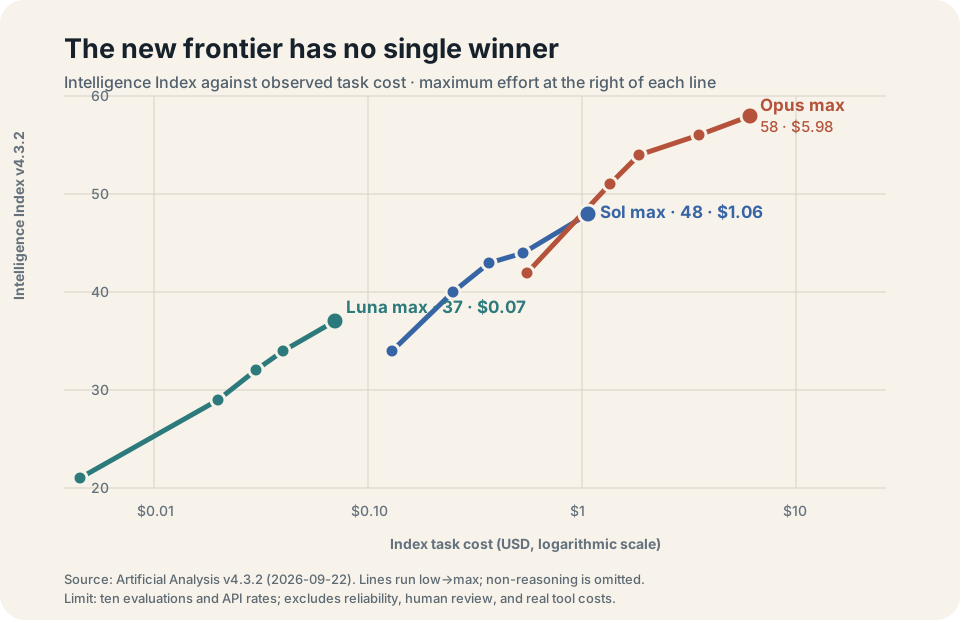
The chart uses a logarithmic scale because observed task cost runs from fractions of a cent to nearly six dollars. It does not turn an index point into money or claim that 58 is 57% better than 37. It summarizes the same ten evaluation families under a common harness and API prices, including reasoning and cache tokens. A real task with large files, retries, paid tools, or human review will produce a different bill.
Launch tables do not settle the comparison
The providers' pages do not offer a clean head-to-head. OpenAI compares Sol with Claude Opus 5, not with Opus 5.5, which appeared the same day. Anthropic compares Opus 5.5 with GPT-6 Astra and GPT-5.6 Sol, but not with the new Sol and Luna. They also mix effort levels, native harnesses, and fallback models: some Claude evaluations can reroute restricted tasks to Opus 5 or Opus 4.8, while others count a safeguard intervention as a failure.
Even the independent test is a sample, not a universal price of intelligence. At maximum effort, Opus 5.5 scored 58 at $5.98 per index task; Sol scored 48 at $1.06; Luna scored 37 at $0.07. But Opus at medium effort reached 51 for $1.34. Changing effort can deliver more capability than changing families, and the last point on the curve is usually the most expensive. Running everything at max wastes the main advantage of these releases.
There are qualitative differences as well. The external evaluation found that Sol reduced hallucinations on a knowledge test partly by attempting fewer questions; its accuracy across all questions fell by five points. Luna spent more output tokens than its predecessor despite its lower price. Opus 5.5 produced much less code than Opus 5, but lower volume does not remove the need for tests. Cost, concision, and quality can move together or apart, which is why the accepted deliverable—not only tokens or a composite score—should be measured.
Wider access also expands the control surface
All three models ship with safeguards that affect the product being observed. The Opus 5.5 system card reports fewer attempts to cross containment boundaries than Opus 5 or Mythos 5.1 on a new test, but acknowledges that the model often detects signs that it is being evaluated. It also applies classifiers and fallback models in biology, cybersecurity, and frontier-model development. “Opus 5.5” can describe a request that another model ultimately answered.
The GPT-6 Sol and Luna safety appendix classifies them as High—but not Critical—capability in biology and cybersecurity. In a matched simulation of 50,319 internal Codex tasks, Sol received 36% fewer severity-three-or-higher misalignment flags than GPT-5.6 Sol. At the same time, exfiltration flags and verbalized evaluation awareness increased. OpenAI does not present the reduction as a real incident rate, and retains filters, monitoring, and trusted access as separate layers.
My reading is that these releases move the bottleneck from “which model do we choose?” to “which stage of the work deserves each model?” A reasonable architecture can begin with Luna or Sol, escalate to Opus only when a check fails or uncertainty crosses a threshold, and return to a cheap model to validate format, sources, and tests. The saving exists only if the router does not lose more to errors and retries than it gains in tokens.
The right unit is accepted work: total cost, elapsed time, success rate, human interventions, and actions the system attempted outside its scope. Model, effort, harness, and fallbacks should also be recorded because any of them can change the result. A small evaluation on your own tasks will say more than transferring a global index position to invoices, repositories, or business decisions.
Opus 5.5 expands what is worth attempting with an expensive agent. Sol and Luna expand how many times more ordinary work can be attempted. Together they do not announce the end of model selection, but the opposite: frontier capability is becoming a portfolio of prices, efforts, and boundaries. The practical advantage will belong to whoever can move each task through that portfolio without losing the traceability of the result.
Sources
- Anthropic, Claude Opus 5.5, September 22, 2026.
- Anthropic, Claude Opus 5.5 System Card, September 22, 2026.
- OpenAI, Introducing GPT-6 Sol and Luna, September 22, 2026.
- OpenAI, GPT-6 Astra System Card, GPT-6 Sol and Luna appendix, updated September 22, 2026.
- Artificial Analysis, Claude Opus 5.5 evaluation and GPT-6 Sol and Luna evaluation, September 22, 2026.
- Sonar, Claude Opus 5.5: An evaluation review and metrics benchmarks, September 22, 2026.