JOURNAL / 2026.09.24
Claude finds ART: what the agent discovered and what remains unproven
Claude agents detected a repetitive DNA array beside reverse transcriptases and the lab confirmed that it is expressed; the finding begins real research, but does not yet establish a biological function or gene editing.
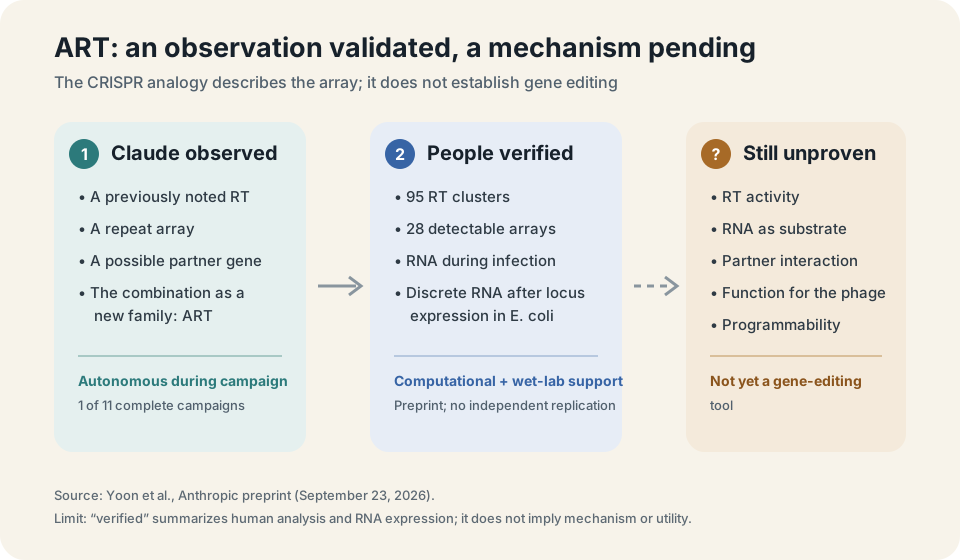
On September 23, Anthropic introduced an in-house life sciences laboratory and its first result: a system of array-associated reverse transcriptases, or ART, found mainly in jumbo phages. The announcement describes an autonomous Claude discovery with properties reminiscent of CRISPR. The 40-page preprint supports a more precise—and, in my view, more interesting—claim: an agent found a regularity in DNA outside its immediate objective that earlier analyses had not described, and that observation survived a first round of human experiments.
No new gene-editing tool appeared. ART's natural function is not even known yet. What is new is a family of loci that brings together three elements: a reverse transcriptase, a long region of non-coding repeats, and a neighboring gene that probably encodes an associated protein. The enzyme was already present in published genomes; Claude was the one to connect its repetitive flanks and possible partner as a coherent system.
The anomaly was not in the assignment
The campaign began with a more conventional question: find new proteins associated with reverse transcriptases in a metagenomic database. The harness organized Claude Mythos 5 instances as workers, supervisors, curators, and editors. Over 21.5 hours, 949 sessions consumed 215.6 million tokens without human intervention during execution. They catalogued 198,290 reverse-transcriptase clusters, sampled 10,983 loci, and opened 98 follow-up tasks in response to their observations.
ART emerged from a refutation. An agent rejected the idea that a phage RNA-polymerase subunit was the partner protein it was seeking. Its supervisor opened another task to investigate the remaining transcriptase. The next agent directly examined 2,900 nucleotides of upstream DNA and recognized fourteen copies of a short sequence separated by distinct intervals. It then measured the pattern, compared known systems, and searched the literature for reasons the novelty claim might be wrong.
That detour is the capability contribution. A conventional pipeline can search for features that someone specified in advance; here, the model judged that a detail outside the initial filter merited another question. This was not tool-free intuition: it used sequence profiles, databases, code, and review between agents. Nor was it a reliably repeatable search by default, as the later replications would show.
The lab confirmed RNA, not a function
After receiving the report, the human researchers expanded the analysis. They identified 95 related reverse-transcriptase clusters; a nearby array could be detected in 28 of them. The arrays contain between three and twenty-one repeats and differ from CRISPR in important ways: their intervening sequences are much longer, they are retained across related phages, and no cas genes sit nearby. Three families of associated proteins with no clear relationship to one another occupy the system's third component.
The experimental evidence is concentrated on the array. The team reanalyzed public data from an SA1 phage infection and found that the region produces RNA during infection, with short species whose boundaries recur across replicates. It then placed the locus in E. coli and observed similar discrete RNAs. That is an important check: the repeat is not merely a bioinformatic drawing on top of a sequence.
But the preprint itself lists what is missing. It does not show that the reverse transcriptase is active, that these RNAs are its substrates, that the neighboring protein interacts with it, or what advantage ART gives the phage. Still less does it demonstrate that the system can be programmed to cut, copy, or paste DNA. The CRISPR analogy describes the layout of an array; it does not establish the same mechanism or therapeutic utility.
The earlier history reinforces that boundary. In 2021, the sequencing of the MarsHill, Madawaska, and Machias phages already noted the reverse transcriptase and an upstream non-coding region, but not the repeats or associated protein. ART is a substantial reinterpretation of existing data, not the creation of an unknown enzyme from scratch.
A real discovery from a fragile campaign
The most valuable methodological fact sits far from the headline. The authors reran the complete campaign ten times with the same assignment and harness. Almost every run that completed the census sampled ART loci; two pursued the lineage, but none read the DNA upstream of the enzyme and none rediscovered the array. The original result came from one campaign out of eleven.
A more controlled test helps explain the failure. Seven models received the same data in 3,500 attempts. The four most capable models recognized the array in at least 90% of runs when two loci appeared directly in their context. Performance fell when they received 96 loci as files and more tools: in 39% of those attempts they never loaded a continuous stretch of even 200 nucleotides. Access to data does not guarantee that an agent will look at the decisive evidence.
This gap makes orchestration part of the scientific instrument. The model, the route that places information in its context, the criteria for opening follow-ups, and human review all change what phenomenon can be seen. The preprint documents methods, counts, and failures in unusual detail, and part of the validation reuses public data. The released version, however, does not link the harness, full trajectories, or a snapshot of the derived database; externally reproducing the whole campaign requires more than the PDF.
Peer-reviewed systems such as Robin have already generated biomedical hypotheses and analyzed experiments in a lab-in-the-loop cycle. ART adds something different: a general-purpose model reading primary data detected an anomaly that was not an explicit part of its mission. Even so, “autonomous” describes the 21.5-hour search, not the whole project. People chose the question and infrastructure, reviewed the reports, expanded the family, designed the assays, and carried out all wet-lab work.
My reading is that this is an AI-assisted discovery, but one still in its first half. Claude's demonstrated contribution was to start a line of research that a laboratory judged worthy of time and that produced an experimental signal. The next threshold is not another agent or a bigger array: it is establishing the mechanism, repeating the search outside Anthropic, and publishing the materials needed to measure how many findings survive for every persuasive candidate.
If agents make hypothesis generation dramatically cheaper, scarcity will move to expert attention, experiments, and replication. The ten failed runs do not invalidate ART; they show what agentic science must measure: not only whether it finds something once, but how often, through what path, and with how much independent evidence it turns an observation into knowledge.
Sources
- Anthropic, Claude discovers a novel enzyme system with CRISPR-like repeats, September 23, 2026.
- Yoon et al., Autonomous AI agents discover reverse transcriptases with tandem repeat arrays, Anthropic preprint, September 23, 2026.
- Zhang et al., Interactions between Jumbo Phage SA1 and Staphylococcus: A Global Transcriptomic Analysis, Viruses, 2022.
- Korn et al., Comparative Genomics of Three Novel Jumbo Bacteriophages Infecting Staphylococcus aureus, Journal of Virology, 2021.
- Ghareeb et al., A multi-agent system for automating scientific discovery, Nature, 2026.