JOURNAL / 2026.09.25
The request to test frontier models in the U.S. before the U.K.
The White House reportedly asked OpenAI and Anthropic to wait for a U.S. review before sharing new models with the British AISI; public facts already show an access queue, but not a confirmed breakdown in cooperation.
Public evaluation of frontier AI now has a geography and an order of passage. Politico reported on September 24 that the White House asked OpenAI and Anthropic not to give their new models to the United Kingdom's AI Security Institute (AISI) until the U.S. government had finished its own review. According to two anonymous sources cited by the outlet, the request came from the Office of the National Cyber Director and is intended to let the United States examine the model and secure its systems before sharing it with partners.
That is important news, but it is not yet a public order. Reuters relayed the core report and noted that the White House, OpenAI, and Anthropic had not responded to its requests for comment. The text of the request, its scope, its duration, and each company's response have not been published. The reported claim should therefore be kept separate from what official documents do establish.
The access queue already exists
The legal and operational foundation is visible. The June 2 U.S. executive order commissioned a classified benchmark for deciding which systems count as “covered frontier models.” It also directed officials to design a voluntary framework through which developers can give the federal government access for up to 30 days before release to other trusted partners and work with it to choose who receives early access. The same order says that it creates no mandatory government licensing or preclearance requirement for model releases.
The request described by Politico would not, then, invent U.S. priority; it would explicitly apply that priority to an allied public evaluator. That is the material change. A window designed to test models and protect U.S. systems can become an international queue in which another institute receives the model later, even after both governments spent years building joint methods.
There is also a verifiable case. In its September 1 launch, Anthropic said Claude Mythos 5.1 was available only to a set of U.S. organizations and that it was coordinating with the U.S. government on broader domestic and international access. The model retains fewer restrictions for biology research and cybersecurity than Fable 5.1, so early access is not merely a commercial courtesy: it enables evaluation of the configuration that concentrates the most sensitive dual-use capability.
The director of the British AISI confirmed in a letter to Parliament that no organization outside the United States had access to Mythos 5.1. He also specified that the institute had tested GPT-6 Astra before its release that same month and retains prerelease access to “some” of the most capable models. This is an uneven picture, not a complete cutoff: Anthropic was absent from one round; OpenAI was not.
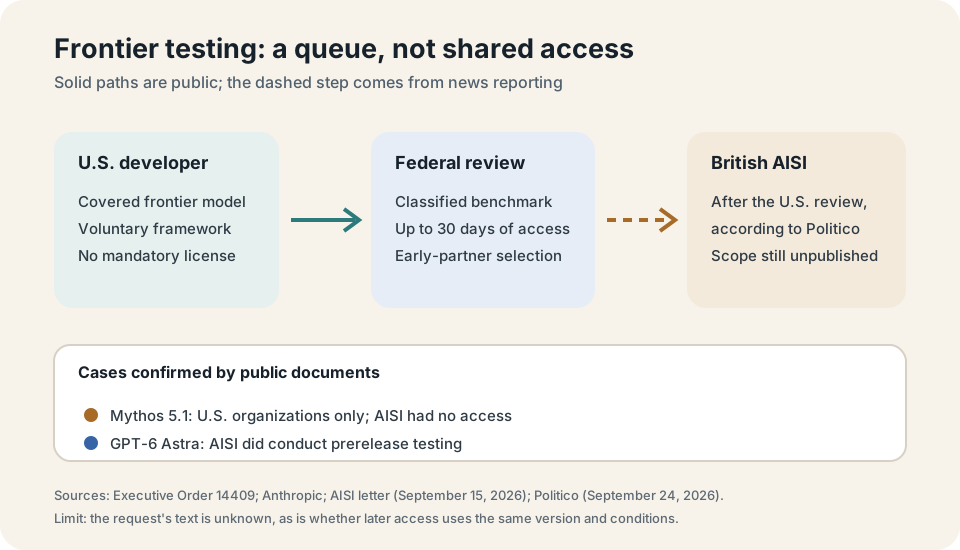
This chronology does not prove that the White House request alone caused Mythos 5.1's exclusion. It does show that the observed outcome fits both the reported ordering and an earlier federal framework. Nor does it establish that the United Kingdom receives a worse version or permanently loses access. Those claims would require the delivered snapshot, dates, and technical conditions.
Redundancy is also a defense
The United States and United Kingdom signed a 2024 memorandum to develop interoperable evaluations, conduct joint testing, and share information subject to their laws and contracts. It does not guarantee simultaneous access to every model or compel a company to provide anything. The episode therefore exposes the agreement's limit rather than a demonstrated violation: scientific cooperation depends on voluntary choices by governments and labs that also pursue national security, industrial advantage, and control over sensitive information.
Giving the developer's home country the first turn has a defensible logic. It reduces the number of early copies, allows defenses to be prepared before new capabilities are disclosed, and concentrates responsibility when a system may find or exploit vulnerabilities. An ordered review does not inherently mean less safety.
But first and only are different architectures. A single review can share the assumptions, tools, and blind spots of the institution leading it. A second team adds value not just by contributing compute: it can try another capability-elicitation method, challenge a classification, or notice that the final configuration changed after the first test. For models modified until shortly before launch, delaying the outside evaluator can leave it less time to influence deployment even if access arrives later.
My reading is that a U.S.–U.K. sequence can work if the first stage leads to a real second review: the same snapshot or documented changes, enough time, shared findings, and the ability to publish disagreements. Without those conditions, “interoperable” risks meaning that one institute produces the verdict while the others inherit a summary. Safety then becomes a sovereignty boundary, not a shared science.
What deserves watching is not another declaration of friendship but four concrete facts: which models are covered; how long U.S. priority lasts; whether AISI subsequently receives the same version with comparable tools; and which findings cross the Atlantic. Today's news is a request that still lacks official confirmation. The more durable fact is already in the documents: early access to the most capable AI is being organized as a strategic resource, and an evaluator's independence depends on having a real place in that queue.
Sources
- Politico, White House asks OpenAI and Anthropic to hold new models from UK testers until U.S. review, September 24, 2026.
- Reuters, White House asks OpenAI, Anthropic to hold models from British testers, Politico reports, September 24, 2026.
- White House, Executive Order 14409, Promoting Advanced Artificial Intelligence Innovation and Security, June 2, 2026.
- Anthropic, Claude Fable 5.1 and Mythos 5.1, September 2026.
- Henry de Zoete, AI Security Institute, response to the Business and Trade Committee, September 15, 2026.
- Governments of the United Kingdom and the United States, memorandum on collaboration on AI safety, April 1, 2024.