JOURNAL / 2026.09.27
Lila finds a palladium catalyst with AI; an electrolyzer test still remains
An automated laboratory screened 2,942 oxides and found a palladium composition stable for 1,000 hours; it is an experimental discovery, not yet a hydrogen technology.
An AI system proposed an unintuitive combination of elements. A laboratory made it, placed it in acid and confirmed that it was still working a thousand hours later. That order matters: the new Lila Sciences result is not an eloquent chemical hypothesis generated in a chat, but a search closed by experiments. Where the sentence ends matters too. The test used a thin film in a laboratory cell, not a complete hydrogen electrolyzer.
Lila presented the finding on September 25, one day after posting the preprint with its methods and results. Its platform examined 2,942 oxide catalysts across 53 material systems and 26 elements. The objective was to improve activity and corrosion resistance together in the oxygen evolution reaction: the slow and aggressive anodic half of proton-exchange-membrane water electrolysis.
Industry relies mainly on iridium and, to a lesser extent, ruthenium because few materials remain active while surviving that acidity. This is a physical dependency, not only an economic one. The U.S. Department of Energy identifies iridium as a scarce material produced as a by-product through a highly concentrated supply chain. Replacing it with palladium would not eliminate precious metals, but it could change the bottleneck if the material retains its performance in a real device.
The finding belonged to the loop, not one model
The architecture combined surrogate models—predictions learned from accumulated results—with several acquisition strategies to decide whether to explore an unknown region or optimize a promising one. A language model operated at that strategic level and prioritized candidates; instruments synthesized, characterized and tested the materials, and the result fed the next round. People moved samples between stations, started instruments and reviewed early decisions and safety in particular. “More than 90% automated” describes the execution of this workflow, not science without humans.
The system eventually concentrated on palladium-rich oxides that the literature did not make obvious candidates. The best, named InMnPdOx, was actually 99.91% palladium by atomic proportion, with only 0.06% manganese and 0.03% indium. Those traces changed the material during operation: an elongated nanostructure network appeared and was associated with lower corrosion. The microscopic association is strong; the exact causal mechanism is not yet established.
In the long-duration test, InMnPdOx kept overpotential below 0.5 volts for more than 1,000 hours at 10 milliamperes per square centimetre and retained 96% of the measured palladium. Palladium oxide without those additives crossed the same threshold at roughly 200 hours; another candidate containing nickel and tantalum did so at around 470. Partial repeats on planar and porous supports help, though they are not independent replication.
Attribution to AI needs another qualification. The authors retrospectively compared their sequential agent with random search, fixed Bayesian optimization, fixed active search and language-model selection. The hybrid agent expanded the activity–stability frontier faster. But that replay uses the pool of materials produced by the original campaign, so it favours regions the original system chose to visit. A second test with a surrogate as oracle reduces that bias but is no longer a physical experiment. The evidence supports that the adaptive strategy led to the palladium family; it cannot tell us how long another laboratory would have taken to find it prospectively.
This limit strengthens rather than weakens the more interesting reading. The language model alone was a worse explorer than the hybrid system. Capability emerged from separating jobs: uncertainty and acquisition in numerical models, context in the language model, data production in the instruments and veto power in people. “AI discovered” is an acceptable shorthand only if the actual subject remains that whole organization.
A thousand hours are not yet a thousand industrial hours
The preprint measures a thin film on a platinum-coated silicon support, in a three-electrode cell, at room temperature and 10 mA/cm². This is enough to compare materials and show that the candidate does not quickly dissolve. It does not report the performance of a complete membrane-electrode assembly, system efficiency, gas production or scalable manufacturing.
The distance is visible in the kind of test other candidates already receive. A peer-reviewed 2026 study operated a cobalt-oxide anode in a membrane electrolyzer for 1,000 hours at 2 amperes per square centimetre, two hundred times Lila's test current density. The chemistries and configurations differ, so this is not a ranking between the materials. It is a concrete indication of the next experimental rung.
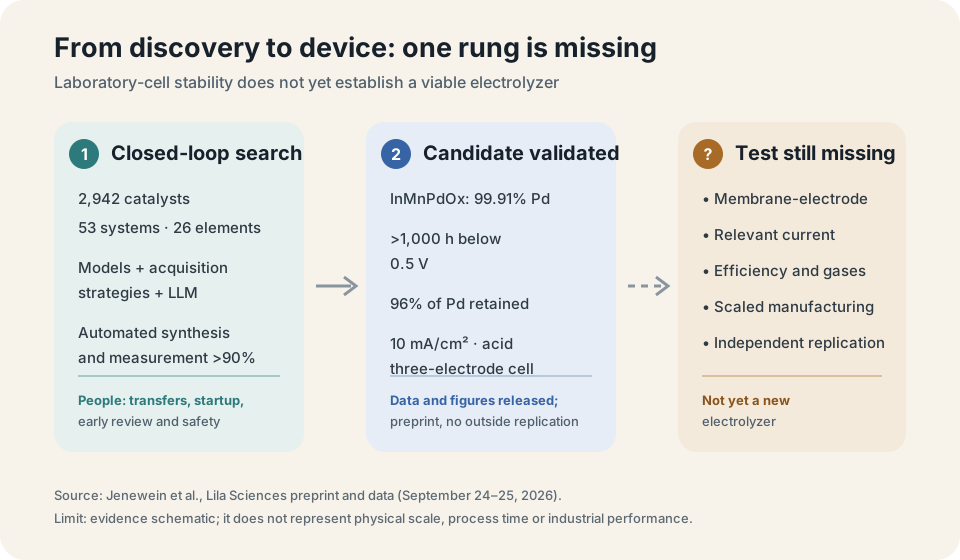
Transparency is halfway there. Lila released a data and code repository that reconstructs the main figures: the map of 1,125 materials with comparable measurements, long-duration curves and benchmark repetitions. It does not contain the controller, models, prompts or trajectories needed to rerun the discovery campaign. The work is also a preprint funded entirely by the company; every author works there, and Lila declares current or potential patent applications related to the materials and platform.
My reading is that the result deserves attention precisely without calling it “scientific superintelligence.” Robotic laboratories combining active learning, perception and experiments already existed—for example, the CRESt platform published in Nature. This work advances something more specific: the search did not optimize activity alone, but pursued activity and stability together and carried an unexpected candidate into a thousand-hour test.
The next important news will not be another count of screened candidates. It will be an outside team reproducing the composition, a membrane-electrode assembly operating at a relevant current density without losing the effect, and a scalable synthesis method. Until then, there is a real chemical discovery and a persuasive demonstration of how to organize AI, automation and human judgment. There is not yet a new electrolyzer.
Sources
- Jenewein et al., AI-guided high-throughput discovery of iridium- and ruthenium-free palladium-oxide catalysts for durable acidic oxygen evolution, preprint, September 24, 2026.
- Lila Sciences, How an AI-run lab cracked open green hydrogen's catalyst problem, September 25, 2026.
- Lila Sciences, data and code to reproduce the manuscript figures, 2026.
- Zhang et al., A multimodal robotic platform for multi-element electrocatalyst discovery, Nature, 2025.
- Liu et al., Cr and Nd co-doped cobalt oxide for stable proton exchange membrane water electrolysis, Nature Communications, 2026.
- U.S. Department of Energy, Water Electrolyzers and Fuel Cells Supply Chain Deep Dive Assessment, 2022.