JOURNAL / 2026.09.28
RetroChimera opens chemical planning, but a route is not yet a recipe
The model combines two ways of proposing precursors, succeeds in blind tests with chemists and releases weights and code; it can explore synthesis routes, not establish that a molecule can be made in the laboratory.
Drawing a molecule is not enough to make it. Someone must decide which bonds to form, from which precursors and in what order, until the plan reaches available materials. Retrosynthesis travels through that problem backwards: it starts from the desired product and proposes successive disconnections. One bad reaction anywhere in the sequence invalidates the whole route.
On September 21, Nature published the peer-reviewed paper on RetroChimera, a model from Microsoft Research and Novartis that tries to improve precisely that first decision. The work did not appear from nowhere: its preprint has circulated since December 2024, and the repository opened an initial version in 2025. This week's novelty is a more useful combination than a cover date: the result enters the Nature record while repository release 1.3 publishes inference and training code and checkpoint links, while adding fine-tuning and a consensus mode under an MIT licence.
That turns an academic claim into something another team can test on its own molecules. It does not turn the output into an experimental recipe.
Two models disagree before they vote
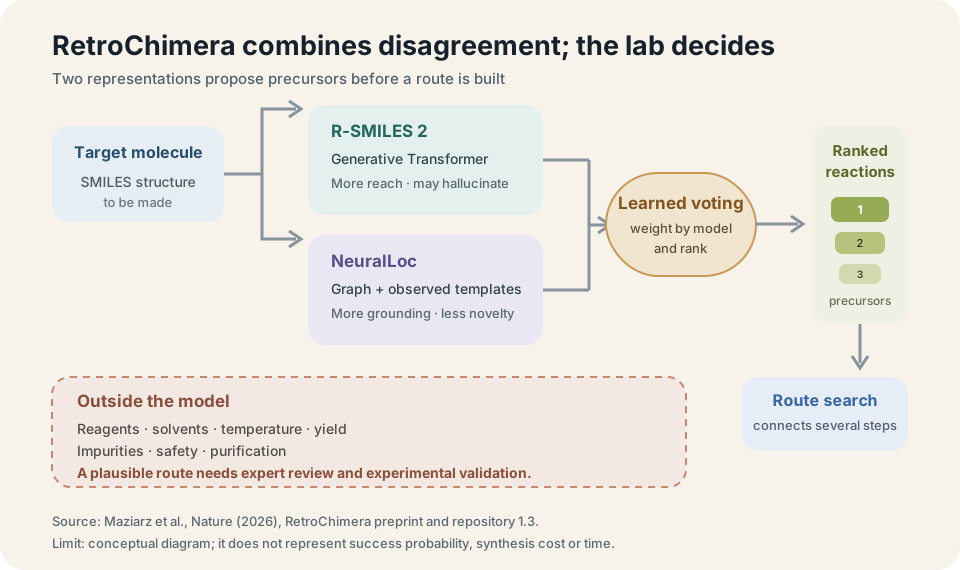
RetroChimera is not a large language model chatting about chemistry. It combines two relatively small models that represent the problem differently. R-SMILES 2, a generative Transformer, receives the target molecule and writes SMILES strings for possible reactants from scratch. It can move beyond familiar examples and retrieve uncommon transformations, but that freedom also lets it invent chemically implausible structures.
NeuralLoc, a graph neural network, instead selects a reaction template extracted from the data and decides where to apply it to the target's atoms. It stays anchored to observed transformations and tends to be more conservative; in exchange, it cannot propose chemistry missing from its library well. In the main checkpoint, the former has 66.7 million parameters and the latter 165 million: the gain does not come from scaling one model, but from exploiting different errors.
Each component returns a ranked list. An ensemble layer learns how much each model's vote is worth at each rank and adds votes when both agree. It can therefore demote a strange generative suggestion that the template model does not recognize, without requiring total agreement and losing every new idea. The paper tests the same strategy with other model pairs and finds that representational diversity matters more than adding similar copies.
The practical effect appears in searches longer than one step. On a set of 800 difficult targets, separated from training and selected because an earlier system could not find a short route, RetroChimera solved more targets than either component when given medium or long search time. Here, “solved” means computationally connecting a target to one of 23.1 million commercially available building blocks through proposed reactions. It does not mean buying those compounds, running the sequence or obtaining the product.
Public benchmarks improve too, but their lesson is bounded. On USPTO-FULL, for example, the recorded reaction appears among the first ten suggestions 79.5% of the time, compared with 78.2% for the generative component. That difference measures retrieval within processed patents; it does not establish that the first selected route is cheapest, safest or reproducible. The paper also acknowledges that different versions of the USPTO set make many published comparisons non-equivalent.
A chemist's preference is not laboratory yield
The most interesting evaluation moves away from matching one historical answer. Nine PhD-level organic chemists—four at Microsoft and five from large pharmaceutical companies—made 599 blinded comparisons between proposals for the same molecule. They did not know which system produced each reaction, and the order was randomized. When RetroChimera's first choice differed from the recorded reaction, the specialists preferred it roughly 64% of the time; the aggregate result was statistically significant.
That is evidence better aligned with use than counting matches alone. A patent preserves what somebody did, not necessarily the best possible disconnection, and the analysis itself found questionable stereochemical assignments or missing reactants in the data. A model can be useful precisely when it does not copy that reference.
But “preferred” means the proposal looks like a better decision on paper. The study did not ask nine laboratories to perform the reactions. Comparisons were not distributed uniformly, cases where two sources agreed were discarded, and this was not an independent multicentre replication: four assessors worked at Microsoft and five at large pharmaceutical companies. They establish alignment with expert judgment under this protocol, not a prospective chemical success rate.
The boundary is explicit in a methodological note: RetroChimera does not predict auxiliary reagents, solvents or reaction conditions. Nor does it estimate yield, impurities, cost, safety or purification difficulty. The repository recommends requesting no more than five or ten alternatives without strict filtering, pairing the planner with a feasibility model and independently assessing every prediction with chemistry expertise. Even then, a computational checker shares some data and biases with the planner; the experiment remains the arbiter.
What opening the planner changes
The strongest checkpoint was trained on Pistachio, a commercial reaction database containing material through 2023. Microsoft releases the resulting model and code, but it cannot turn that proprietary corpus into a reproducible open dataset. It also publishes weaker checkpoints trained on USPTO data and the evaluation configurations. An additional test on 10,444 internal Novartis reactions shows transfer without fine-tuning, although the closed data prevent a third party from reconstructing that comparison.
The opening is still material. A group can run the model locally, inspect how it combines proposals, integrate it with Syntheseus and fine-tune it on an electronic laboratory notebook. It can also confront the model with post-2023 chemistry, natural products or academic domains that the authors identify as potential weak spots. This is a research surface, not merely an endpoint and a provider chart.
My reading is that the valuable advance is not replacing a chemist's judgment, but organizing disagreement better. A generative model supplies reach; a template model supplies memory and constraints; learned voting decides when to trust each. That architecture is less spectacular than asking a chatbot for a synthesis, but it looks more like a scientific instrument: it exposes which layer proposes, which filters and where a different kind of evidence must enter.
The next important test should measure complete routes prospectively. Select targets absent from Pistachio, freeze the proposals before experimentation, and compare time, cost, yield and number of attempts with human planning or another system. Until then, RetroChimera has improved and opened the map of possible paths. It has not shown that the chosen path can be walked in the laboratory.
Sources
- Maziarz et al., Chemist-aligned retrosynthesis by ensembling diverse inductive bias models, Nature, September 21, 2026; preprint and full methods.
- Microsoft Research, Improving synthesis prediction of small molecules at scale with RetroChimera, September 21, 2026.
- Microsoft, RetroChimera repository, training code, checkpoints and warnings, version 1.3.0.
- Microsoft Foundry, RetroChimera model card, accessed September 28, 2026.