JOURNAL / 2026.09.29
Claude Sonnet 5.5 blurs the line between workhorse and flagship
The new Sonnet approaches Opus 5.5 on several tests and cuts time and cost in real workflows, but effort settings and fallbacks can reverse the advantage suggested by token prices.
For years, “Sonnet” meant the practical Claude and “Opus” the model reserved for the hardest work. Claude Sonnet 5.5, released by Anthropic on September 28, makes that hierarchy less useful. On several coding and professional-work evaluations it finishes close to Opus 5.5, costs half as much per token, and is already available through the Claude API, AWS, Google Cloud, and Microsoft Foundry. This is not a claim about future capability: it is an endpoint that can replace the previous Sonnet today.
The more interesting consequence does not fit into “near-Opus at Sonnet prices,” however. The model offers five effort levels; Claude’s app defaults to medium and the developer platform to high. Raising effort makes the system think longer and use more tokens, but does not always improve it. Some requests also activate classifiers and may be served by Sonnet 5. Selecting claude-sonnet-5-5 no longer identifies the capability, cost, or even the model that will ultimately answer on its own.
Anthropic has kept Sonnet 5’s rates: $2 per million input tokens, $10 per million output tokens, and $0.20 per million cache reads. It says the new version generates output more than 30% faster and costs up to 30% less per task because it needs fewer steps. There is outside evidence that this efficiency is real on some work. There is also evidence that it disappears when the dial is turned all the way up.
A real improvement, not a universal multiplier
The most striking jump in Anthropic’s table is on Terminal-Bench 4.0: 70.6% for Sonnet 5.5 against 10.3% for Sonnet 5. The evaluation contains 66 terminal tasks, many in engineering and science, and the new result averages five attempts per task using Claude Code at maximum effort. Opus 5.5 scores 66.4%. With standard errors of about 2.5 points for both models, that gap is not enough to say Sonnet is better than Opus; it does support that its predecessor’s extraordinary failure no longer defines the family.
The size of the gain should not be transferred to all programming either. On FrontierCode, which penalizes unnecessary changes even when they are correct, Sonnet 5.5 scored 52.1% at xhigh effort and only 46.2% at max. The system card attributes part of the drop to the agent launching extra reviews at the maximum setting, which timed out or expanded the change beyond scope. More inference compute produced more activity, not more value under the criterion being measured.
An evaluation by CodeRabbit on real code reviews helps move beyond the provider benchmark. Across 13 difficult pull requests with one known bug each, Sonnet 5.5 found six through actionable comments and Sonnet 5 found four, at similar precision. The model calls averaged $0.47 per review versus $1.16, while the full workflow took 5:27 instead of 9:55. On a second set of 44 reviews, mean time again fell by roughly half, although quality judging was not yet complete. Thirteen cases show direction; they do not establish a general bug-detection rate.
Artificial Analysis found the reverse on its broad index. At maximum effort, Sonnet 5.5 gained 18 points over Sonnet 5 and finished two points behind Opus 5.5, but generated about 193,000 output tokens per task—the most that organization has measured. Its weighted cost was $7.60 per task, roughly 50% above the previous Sonnet. The test used a prerelease deployment with a structured-output bug that has since been fixed, so it needs to be rerun; it still shows why “same rate” does not mean “smaller bill” without naming the effort setting and workload.
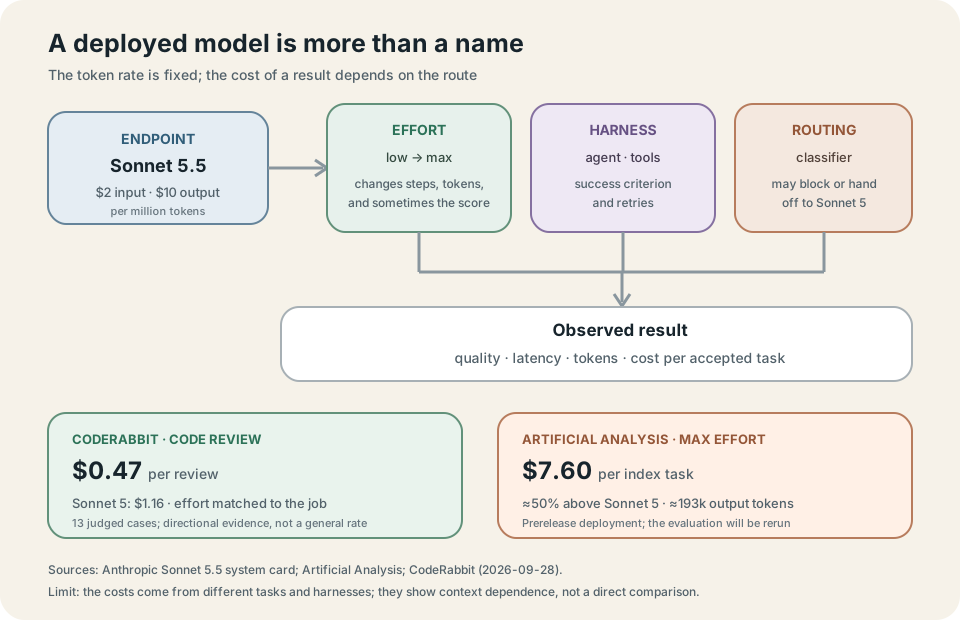
The two measurements do not conflict. CodeRabbit assigned low, medium, and high to three classes of review and compared a specific workflow. Artificial Analysis moved every model through a common suite and observed the max extreme. Together they say something more useful than a ranking: Sonnet 5.5 can be far more efficient than Sonnet 5 when the reasoning budget is matched to the job, and more expensive when “maximum” substitutes for that decision.
An endpoint is also a routing policy
The model’s cybersecurity capability rose enough to change the product. Anthropic says it remains below Opus 5.5 and Mythos 5.1, but it is the first Sonnet released with the company’s stricter cyber classifiers. In Anthropic’s own products, and for developers opted into API fallbacks, a blocked high-risk request is visibly handed to Sonnet 5. Other providers may apply different behavior. Biology controls block without an alternative model.
That detail reached the capability numbers themselves. On Terminal-Bench, the classifiers flagged 1.2% of Sonnet 5.5 requests and affected 1.5% of trials; the server then answered with the fallback model except in one case. It is a small fraction, but enough for a “Sonnet 5.5 score” to describe a system made of a model, agent, tools, network, and safety router. The system card’s cybersecurity evaluations, by contrast, disabled those filters to measure the underlying model. Both results are legitimate, but they answer different questions.
My reading is that the important advance is not a fixed intelligence becoming cheaper. Anthropic has brought much of the top tier’s capability into the model that can run at volume, while shifting more responsibility to the integrator. The choice is no longer just “Sonnet or Opus”: it is which effort to assign to each stage, when to escalate to Opus, which fallbacks the product accepts, and what retries and human review cost.
That calls for a different buying unit. For a repeated task, teams should measure cost per accepted result under the same harness, including tokens, caching, tools, failures, latency, and review time. They should also record the effort setting and which model actually answered. Price per million tokens remains necessary for billing; on its own, it has become a poor description of what is being bought.
Sonnet 5.5 looks like a good workhorse precisely because it does not require paying for its ceiling every time. But the advantage exists only if the system knows when to stop thinking. In this generation, using a model well matters almost as much as choosing it.
Sources
- Anthropic, Claude Sonnet 5.5, September 28, 2026.
- Anthropic, Claude Sonnet 5.5 System Card, September 2026.
- Anthropic, Claude Sonnet 5.5 model documentation, accessed September 29, 2026.
- Artificial Analysis, Claude Sonnet 5.5 reaches #2 on the Artificial Analysis Intelligence Index, September 28, 2026.
- CodeRabbit, Claude Sonnet 5.5 for code review: More catches than Sonnet 5, in half the time, September 28, 2026.