JOURNAL / 2026.10.08
Claude Haiku 5.5 makes delegation cheaper: which work should it handle?
Anthropic launches a Haiku with adjustable reasoning and much lower rates for short requests. The advance opens up tasks that were hard to justify, but completing steps and delivering a correct result remain different measures.
Claude Haiku 5.5 arrived on October 7 with a proposition that could change product design: making small, repeated tasks viable at scale. Anthropic's announcement positions it for summaries, classification and bounded tasks within agents. It is already offered on its platform and on AWS, Google Cloud and Microsoft Azure. The release matters because a useful extraction from one document may be dispensable if performing it across every document costs too much.
Consider an assistant preparing a report. Finding a figure, checking its unit and returning the source page are bounded assignments that could be delegated. Deciding whether that figure supports a conclusion requires broader judgment. My reading of the release is that it expands the options for separating these jobs. Savings matter if they help preserve the evidence the decision maker needs; multiplying summaries without references can make the report harder to review.
The model overview sets two price tiers on the Claude Platform. For prompts up to 100,000 tokens, it charges $0.10 per million input tokens and $0.50 per million output tokens. Above that threshold, the rates rise to $0.50 and $2.50, respectively. The context window supports one million tokens: context capacity and the cheaper pricing tier have different limits. According to the announcement, Haiku 4.5 cost $1 and $5 per million; the per-token reduction is substantial, but it does not automatically mean the same reduction per task.
There is a concrete reason to recalculate. The migration guide says the same text produces approximately 30% more tokens than on Haiku 4.5, varying with the content. A file previously close to the threshold could move into the higher tier. Reasoning also consumes part of the output limit. An integration needs to revisit its budgets and how it reads responses, alongside changing the model identifier.
Completing steps does not mean completing the assignment
The system card, section 8.9.3, offers a particularly useful distinction. Across 82 offline computer tasks in OSWorld 2.1, Haiku 5.5 earns a 72.4% partial score, but satisfies every checkpoint on 37.1% of tasks. These are averages over five independent attempts per task, at maximum effort. The 72.4% is neither a complete-task success rate nor a description of the API's default setting.
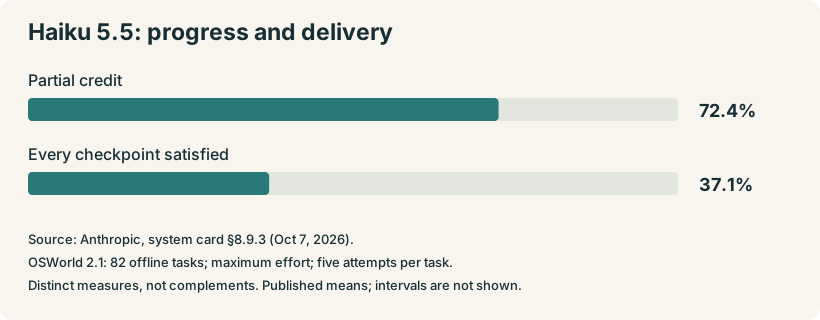
That does not diminish the advance. It helps decide where to use it. If an agent finds the correct row but saves the final file incorrectly, it has made progress without delivering what was requested. A product that delegates needs to check the received object: a file, a code change or a datum with its reference. A persuasive account of what the agent supposedly did cannot replace that check.
The behavioral documentation makes the tradeoff concrete. Default effort is medium. At low, particularly with long instructions, the model may skip searches, stop early or omit checks; at low and medium it can report a code change as complete without testing it. Anthropic suggests instruction and effort adjustments, with higher consumption. This argues for evaluating the cheapest workflow that completes the assignment, including verification, rather than always picking the minimum setting.
There is also external evidence: Artificial Analysis evaluates the max variant using a suite covering coding, agents, knowledge and reasoning. It characterizes token generation as fast, but output as very verbose. That speed alone does not measure time to a useful answer: reasoning can extend the wait. Nor does a broad suite validate our Spanish document extraction. We have not run Haiku 5.5 here.
I would start with a narrow assignment whose output is easy to review: extract a datum from known documents, cite its location and recognize when it is missing. I would compare Haiku 4.5 and 5.5 on those same cases, counting errors, retries, time and review. Ambiguous cases would go to another model or a person. This is an evaluation proposal, not an observed result.
The practical change deserves attention: there is more financial room to add small checks and lookups to a product. The decision to delegate should still depend on what we can verify. Haiku 5.5 can make more work affordable; designing a checkable delivery is what would let us benefit without turning volume into another review burden.
Linked sources accessed October 8, 2026.