JOURNAL / 2026.10.15
Grok Voice 3.0 improves voice support: what changes when migrating
The new model reaches the API with more tasks resolved in an external evaluation and the same base price. The comparison with 2.0 shows why capability, speed and compatibility need separate scrutiny.
A phone assistant can answer immediately and leave the problem unresolved. It can also get things right after an unbearable conversation. The release of Grok Voice 3.0, announced on October 14, deserves attention because it lets us examine both: a new speech-to-speech model is available through the API, with external evidence of improvement on support tasks. There is no need to wait for a future demonstration.
The most useful comparison is in Artificial Analysis’s current results: on τ-Voice, Grok moves from 56.5% of tasks resolved with 2.0 to 71.6% with 3.0. Average time to first audio, on a different test, moves from 0.70 to 0.81 seconds. Resolution improves, but that measurement does not show a faster initial response than its predecessor.
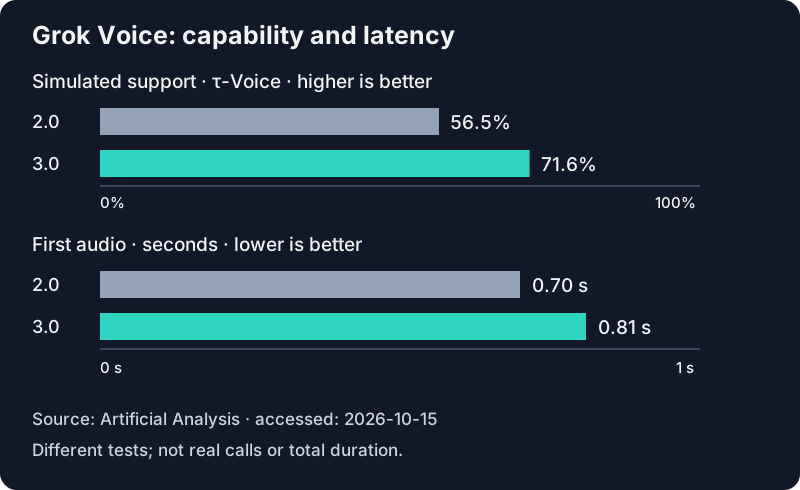
It helps to understand what resolution means. The original τ-Voice paper combines a simulated voice user, tools and policies in domains such as retail, airlines and telecoms. It evaluates verifiable changes in task state while introducing conversational difficulties, noise and accents. That is considerably more demanding than judging whether an answer sounds convincing. It remains a simulation: the percentage is not a forecast of real calls handled without assistance, nor does it measure every situation a business will encounter.
Artificial Analysis’s methodology also specifies that time to first audio is measured using Big Bench Audio questions. It is not the time to complete a return or confirm a booking. Moreover, the aggregate index changed composition after 2.0 launched; comparing historical headlines about that index would mix methodologies. That is why we retain specific metrics and the current comparison here. A voice that starts promptly may still be waiting for a tool to finish what matters.
There is technical continuity. The July announcement of 2.0 already described a speech-to-speech model with improvements in tools and conversation. This version advances that product; it does not itself introduce the possibility of building phone agents. What changes for developers is the observable capability available within an existing integration.
The release notes contain an immediate consequence: grok-voice-latest already points to 3.0, and 2.0 is deprecated. Anyone who chose the alias receives the change automatically. The migration and usage guide retains the endpoint, session parameters and events; it allows pinning grok-voice-3.0 and explains that the application executes custom functions. That compatibility makes adoption easier, but preserving the protocol does not establish that every conversation will behave the same way.
The published pricing retains $0.08 per minute of voice, with additional charges for text inputs and tools depending on usage. That base price is not the full cost of resolving an issue: telephony, connected systems and any human intervention the service requires still need accounting for. We have neither run the model nor measured its performance in Spanish.
My view is that this improvement deserves a trial on complete tasks, with room to make mistakes during evaluation and strict criteria before acting on real accounts. I would choose cases where the caller interrupts to correct an address, changes their intention or needs a transfer to a person. I would check both the recorded outcome and what the agent claims to have done. A nonexistent refund can sound impeccable.
For me, the value lies in reducing calls that appear to end well but force people to contact support again. A slightly longer wait may be worthwhile if it prevents that repetition; a benchmark alone cannot establish the trade-off. The automatic version change makes that check particularly urgent: a new model reaches the integration easily, but the service still has to demonstrate that it provides better support.
Primary sources consulted on October 15, 2026. The chart reproduces published measurements, not our own tests.