JOURNAL / 2026.10.24
Claude and Theorem bring formal verification to real library binaries
Anthropic reports proofs covering 239 entry points across 123 libraries. Public artifacts expose a subset and clarify what it means to prove that an executable does not fail.
Anthropic and Theorem have presented formal verification research in which Claude writes proofs about executables from open-source libraries. They report results for 239 entry points across 123 OSS-Fuzz libraries. The scale matters, but the practical change is starting from existing software and its tests without requiring every library to be rewritten in a verification language.
The starting point is a fuzz test: a small program that calls a library with generated inputs to look for failures. Running it millions of times can uncover an error; it does not prove that no input can trigger one. Here, that program is compiled for RISC-V, a property of its execution is specified, and Claude attempts to prove it. The Rocq kernel checks the proof. Proof acceptance depends on that check, rather than the model announcing it has finished.
The technical appendix explains a crucial detail: proving that the AddressSanitizer-instrumented version does not fail leaves its relationship to the normal version unresolved. The work therefore examines both versions, their freedom from errors and their observable behavior. The experiment describes inputs below 64 MiB, memory limits and single-threaded static executables. The result concerns that defined environment.
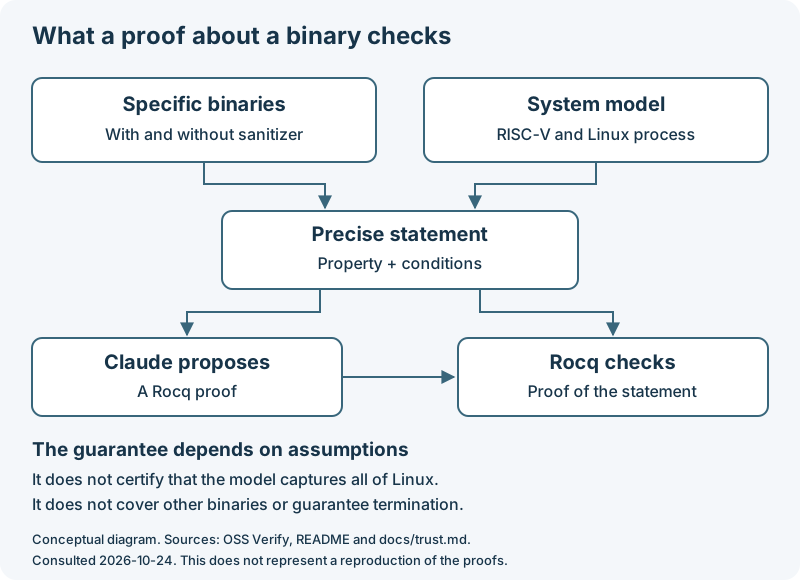
There is a difference between the announced scale and what we can inspect today. The public proof repository lists proofs for 60 entry points across 25 libraries. This is a published subset, rather than a public reproduction of all 239 results. Its documentation also makes something explicit that the announcement's language can obscure: the published proofs do not rule out an infinite execution. Summarizing them as “these programs always terminate successfully” would be inaccurate.
The results index distinguishes, for example, proofs involving different sanitizers and conditions on which system calls may fail. That granularity is useful: it lets us ask about a particular binary and statement, rather than accepting a generic verified-library label. A specification appearing in the catalog does not mean it has been proved, either.
The Linux process model documentation acknowledges its boundaries. It runs no signal handlers and describes no concurrency between threads; its file system omits permissions and symbolic links. A correct proof within that model does not by itself certify the behavior of a real service relying on those features. Nor does it automatically transfer to another binary compiled for ARM or x86.
The trusted base also deserves attention. It includes Rocq and its permitted axioms, the execution semantics, tools that turn the executable into a memory image, and the wrapper connecting proof and statement. Verifying the binary avoids having to prove that the compiler preserved the source code for that result; the guarantee instead attaches to those exact bytes. Updating the dependency requires establishing again what carries over.
I find this a more substantial advance than generating a large volume of proof code. It lowers a practical barrier: attempting precise guarantees about dependencies we already use. The number of generated lines tells us little about that usefulness. The covered property, the ability to check it separately and the work needed to maintain it as the program changes matter more.
There is also a tension when the agent can patch the code it is trying to prove. The announcement acknowledges the risk of satisfying the goal by trivializing the program and describes patch audits. My criterion would be to review separately whether a patch preserves the intended function. A decoder that rejects every file might avoid failures while being useless.
For a team, I would start with one critical dependency, one specific entry point and a property with clear consequences. I would ask for the statement, the binaries and a reproducible check before expanding coverage. This research offers a credible route to try that; it does not yet establish the cost of maintaining it in an ordinary application.
Primary sources consulted on October 24, 2026. We examined the documentation and public catalog; we have not run the verifier or reproduced the proofs.