JOURNAL / 2026.09.20
Epoch AI: one in four math preprints discloses AI use
A new arXiv census finds a rapid rise in disclosed AI use in mathematics; the trend is clear, but the boundary between “assistance” and “substantial contribution” depends heavily on how it is measured.
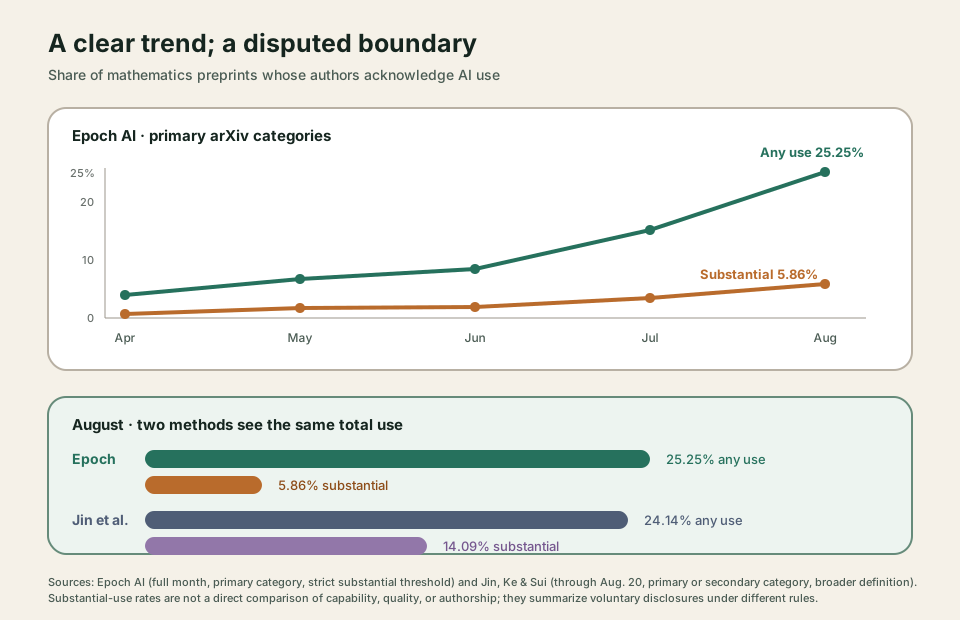
In August, 1,453 of the 5,754 mathematics preprints examined by Epoch AI acknowledged some use of artificial intelligence. That is 25.25%, up from 3.89% in April. The jump does not mean a machine wrote one in four papers, solved their main results, or made those results correct. It says something narrower and still important: in four months, disclosing AI in a mathematics preprint went from exceptional to visible across a substantial share of arXiv output.
Epoch separates writing polish, code, literature search, and research assistance. Within the same August set, 337 papers—5.86%—credited an AI with a contribution the project classifies as substantial research: proposing a main result or statement, finding a specific result, or making an essential part of a proof. This is a deliberately demanding category, close to the contribution level that would justify human coauthorship. It does not turn the model into an author or verify the theorem; it records what the human authors chose to credit to it.
The figure arrives after months of results that looked extraordinary in isolation: batches of Astra advances, a new bound for zeros of the zeta function, and the Navier–Stokes proposal. The new dataset does not show that those cases are representative. It does show that provenance is no longer a question confined to a few laboratory announcements.
A census of disclosures, not invisible use
The Epoch explorer starts from every paper whose primary arXiv category is mathematics and analyzes the source text of papers posted since 2023. It first searches for terms related to models and assistants. GPT-5.6 Sol reads the documents that pass that filter, decides whether they contain a genuine use disclosure, and extracts the passage supporting each label. Claude Fable 5 rereads every research or formalization case and reviews the remaining passages; a literal string check removes quotations that do not appear in the original.
The methodology includes controls that make the result more inspectable than a keyword search. A mathematician reviewed 200 research-related label-passage pairs, agreeing with the passage in 91% and with the research category in 93%. Agreement was 98% for another 50 non-research cases. Sol also read 250 papers from 2026 that did not trigger the initial filter and found no AI disclosure. The public repository preserves the arXiv identifier, label, passage, named tools, and second-reader validation for each classification.
That makes individual errors auditable, but it does not turn the result into direct observation of work. Epoch counts only voluntary disclosures printed in the paper. It does not detect omitted uses, comments hidden in source files, or stylistic signals; a change in community norms could lift the curve even if actual use grew more slowly. It also uses the latest version available on September 5 and assigns an acknowledgment added in a revision to the month of the first submission. The series therefore mixes adoption, willingness to disclose, and retrospective revision.
The project tests whether the rise comes only from new entrants. Among 2,682 August papers with at least one author who published regularly before 2023 and also meets a journal-publication threshold, 24.91% disclosed AI and 5.59% disclosed substantial research—almost the same as in the complete set. This is a useful comparison, not a longitudinal panel of the same people. Nor does it reveal how many independent teams sit behind the papers or whether AI increased their productivity.
Adoption replicates; the contribution boundary does not
An independent check is especially revealing. For The Gold Rush in AI4Math, Jin, Ke, and Sui analyzed 32,944 submissions that included mathematics as a primary or secondary category between March 1 and August 20. For the August portion, they found disclosed use in 24.14% of papers. Epoch, using the complete month and primary categories only, finds 25.25%. The populations are not identical, but the proximity of the estimates strengthens the basic signal: the increase does not appear to be an artifact of one classifier.
The projects diverge exactly where it is most tempting to manufacture a headline about authorship. Jin and colleagues call 14.09% of their August submissions “substantive”; Epoch assigns 5.86% to its corresponding top category. The gap does not prove that either is wrong. The first study includes proof construction, problem formulation, formalization, verification, and other research assistance under a broader boundary. Epoch reserves its top tier for language crediting a key, essential, or coauthor-level contribution, requires agreement between two models, and places vague assistance in another category. The Jin study used GPT-5.6 Terra with supporting quotations and says its manual validation remained in progress.
The disagreement is part of the finding. “AI was used” can be measured with fairly high agreement because it is often an explicit sentence. “AI did substantial research” requires interpreting how much an idea, proof, verification, or iterative conversation mattered to the final result. A single scale loses information: correcting LaTeX, suggesting a lemma, and generating the main proof are not three intensities of the same task.
Attribution must not be confused with validity, either. An acknowledgment can honestly describe a decisive contribution to a proof that later turns out to contain an error. Conversely, a formal certificate may establish that a term compiles under certain axioms without resolving whether the statement faithfully represents the problem or whether the result is novel. Counting disclosures answers who or what participated according to the authors; mathematical review answers whether there is a result that should enter the body of knowledge.
My reading is that 25% will not be the durable number, because it may move as quickly as models and disclosure norms do. What will endure is the need for more structured provenance in scientific papers. A free-form note at the end of a PDF is no longer enough when the same system can search the literature, propose the statement, write code, generate a proof, and formalize it.
A useful disclosure should identify the tool and version, separate the tasks performed, link verifiable artifacts where they exist, and explain the human review applied to each AI-attributed claim. There is no need to publish complete private conversations or pretend every interaction can be reconstructed; there is a need to distinguish writing polish from an idea without which the theorem would not have appeared. Final responsibility should remain with people who can answer objections, correct the text, and withdraw a claim.
Epoch has built a good first counter precisely because it publishes denominators, definitions, and correctable passages. Its disagreement with another study identifies the next task: establish a vocabulary of contributions that survives a model change and allows comparisons across months, fields, and journals without deciding authorship through an adjective. One in four is an adoption signal. Learning what part of mathematics changed still requires reading how each result was obtained.
Sources
- Tara Abrishami, Epoch AI, In August, 25% of math preprints acknowledged AI use, up from 4% in April, September 18, 2026.
- Epoch AI, AI Use in Math Research explorer, methodology and limitations, and reproducible data, accessed September 20, 2026.
- Jiashun Jin, Zheng Tracy Ke, and Bingcheng Sui, The Gold Rush in AI4Math: Where Are We Now?, arXiv:2608.24961, August 25, 2026.